Category: Alaska

  • THE WHITE PASS TRAIN

    Trains are a big thing in Skagway.  The town is  headquarters for the White Pass-Yukon route.  That's the same route that the Klondike goldrush stampeders followed in 1898.

    Skagway rail trip-001


    We traveled that 67 mile route — from Skagway to Carcross (Yukon Territory Canada) — much more comfortably than those intrepid adventurers.  Our trip was on a train like the yellow and green one in the photo above.  The red train has a huge snowplow on the front (scary to think about the tracks that would need that) and the black one is a steam train that also makes the same trip we took.)

    Skagway rail trip1-001
     

    P1020516 

    Above, some samples of the beautiful scenery along the route.  

    Although the day started off overcast, the skies turned blue about the time we reached the US/Canada border.    


    P1020449


    I really like looking out the train window as the train goes around a curve and seeing the engine up ahead.  So here is my obligatory photo of that event.    We went through several tunnels and over several bridges which I am sure were safer than they looked.   (There actually had been a derailment earlier in the season … and we knew about that, but still took the chance.  Call us crazy!)

      Skagway rail trip5

    More scenery and me standing on the platform between cars.  It was a great spot to take pictures  (if you could do that with one hand on the rail — it was a little wobbly).  

    The journey was narrated by an excellent guide, but you couldn't hear him when standing on the platform.  So it was a hard choice to make.  Shortly after Bill took this picture and went back to our seat, the train entered another rather long tunnel.  Of course I didn't hear the announcement (and nobody remembered to come get me.  How quickly they forget!).  That was a little spooky.


    Skagway rail trip4


    The train entered Canada at Fraser BC and stopped for a welcome rest stop.  The actual border (in the first picture above) is several miles from Fraser, but it gets so snowy at that particular spot that both countries have their stations in a lower location.

    (This is Part One of the rail trip — more on Tuesday)

    I am linking this post to SKYWATCH FRIDAY (thanks to Yogi, Sylvia, and Sandy) to Gemma's SCENIC WEEKENDS and to Judith's MOSAIC MONDAY.  Thank you to all the hosts for these great memes.  


  • NO SPITTING in front of my fence!

     For  SIGNS SIGNS  and GOOD FENCES –  two memes that I've been away from for too long.


    Views of a pretty little yard in an 'off-the-beaten-track' Skagway neighborhood.  (We were looking for a place to walk that was away from the hordes of tourists — pretending we weren't part of them.) 


    P1020633


     The people who live in the home are probably one or two of the 900 year-round Skagway residents.  The population of the town doubles in the summer because of the seasonal workers who are employed to help with the influx of tourists.  The town has over 900,000 summer visitors!  Those cruise ships bring a lot of people (this post).

    I'm pretty sure the sign was meant to be funny.  Although who knows how much sense of humor those 900 residents can maintain during the summer season!


      Skagway


    Thank you to Theresa at the RunARound Ranch for GOOD FENCES and to Lesley for SIGNS SIGNS.

    I've missed these memes.

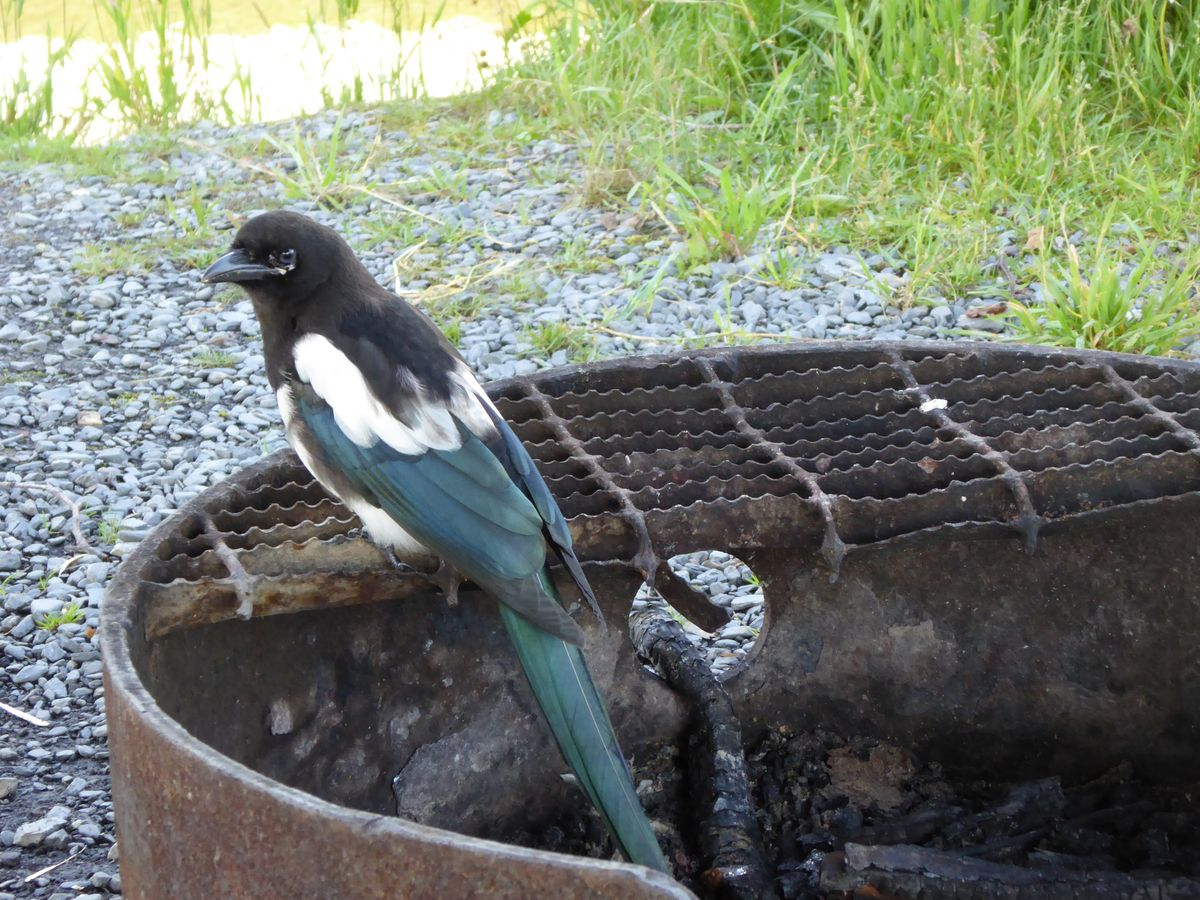
  • MAGPIES


    We saw Magpies all the time when we were growing up in Eastern Washington.   Bill even remembers (sadly) that there was a bounty on them when he was a child — for some reason ranchers thought that the birds harmed cattle. 

    P1020185


    After we moved to (western) Oregon in 1971, we never saw these birds except when we went back to Washington to visit family.    A year ago, we made a trip to our old hometown for the first time in years and again we saw a lot of these striking birds.  We talked about how they are so common in that part of the state but you never see them in western Washington or Oregon.  I didn't get any pictures then though.

    P1020176


    But this summer we saw them everywhere in Alaska.   This one posed for me at Blueberry Hill Campground near Valdez.   He wasn't a bit afraid.  We were the only people in the Campground, so I don't know whether he was used to people or just didn't know enough to be afraid of them (us).  

    P1020177


    Not the loveliest place to pose, but somehow the light made his feathers look so beautifully greenish-blue, I just had to include it.  (All photos are the same bird, taken within about half an hour — and I didn't mess with the pictures at all, except to add the borders.)


    Shared with WILD BIRD WEDNESDAY.  Thank you to Stuart.


    Magpies are a member of the Crow family (Corvidae) and they sound very much like crows.  But I think they are prettier.

  • SKAGWAY

    Haines (this post) and Skagway are only about 15 miles apart by water — Skagway is at the end of the Lynn Canal.   By land, the only way to get from one to the other is 350 miles, back into Canada through part of the Yukon.  


    P1020420

    view of Skagway Harbor from the ferry


    So of course we chose the water route — taking another Alaska Ferry, very much like the one we traveled on (back in early June) to Alaska from Washington State.  But this one just makes the one-hour crossing between the two cities several times daily.  

    P1020632-001As we did in Haines, here we also stayed in an RV Park within easy walking distance of the town center.  But Skagway seemed to us like a made-up town.   Three to five cruise ships were docked every day we were there — and when the passengers disembark they by far outnumber the population.   Many of them walked right by our RV Park on their way into town, so when we were at "home" it made for good people-watching.


    P1020613-001


    This picture, from a viewpoint above town, is a graphic example of how the giant cruiseships dwarf the town —  Skagway really does exist (these days) almost solely to cater to these tourists.  Skagway's downtown blocks are charming at first glance, wooden sidewalks and some old buildings dating from the Yukon goldrush. But there are almost no locally-owned stores.


    P1020625-001


    The driftwood-covered building above was (in goldrush days) home to the Alaska Brotherhood lodge.  Now it is a Visitor Center for the Klondike National Historical Park.    Next to it (on the left of the picture) is a jewelry store.   Most Skagway storefronts are occupied by jewelry and "gold" stores.  Not our thing anyway and besides nearly all of them are owned by the cruise lines… tailor made so that cruise passengers who may only have a few hours in town can spend their money on something "local."  

    But … although we didn't love Skagway the way we did Haines, we were really glad that we stayed there …. 

    P1020647

    Shameless teaser about the next post

    …because of the adventures we had when we got away from the town itself.  (And that's another post or two. )   


    SHARING WITH:  Wednesday Around the World.  A new meme for me, hosted by Betty who blogs beautifully from New Zealand.  Thank you Betty.


  • HAINES — birds, beasts, and a charming town


    Most of the time we spent in Haines, we were exploring outside of the town…

    P1020410-001
     

    …  watching birds, gazing at scenery, taking a few pictures, fishing a bit,  and watching other wildlife:


      P1020367

     (Like this guy on the way to his favorite fishing hole.)

    But we also really enjoyed the little town.   Here are some of the views of this picturesque  area:


    2014-08-231
     

    Like most places in Alaska, Haines is nowhere near a city of any size.  Because of its location and small population, I had expected a tiny village with few amenities.   I was pleasantly surprised.   It actually does not have chain stores and that was OK by us.  It's sweet to see a town that doesn't look like every other place you visit. And besides,  the local merchants offered  everything we needed (good grocery stores and restaurants for us mostly, but there were other stores, none  of which seemed overtly 'touristy'.)  

    This bald eagle was fishing near Haines at the same time Bill was.


    2014-08-29

    About 3500 Bald Eagles migrate into Haines in late Fall and the town hosts the Chilkat Valley Bald Eagle Festival in November.  (I'd love to be there   —  if only it weren't already so cold by then!)  But we were just happy to see a few of the ones who make their home permanently in the area.  

    SHARING WITH:  MOSAIC MONDAY (thanks to Judith, the new host)  OUR WORLD on Tuesday (thank you to the team Arija, Gattina, Lady Fi, Sylvia, Sandy and Jennifer) and WILD BIRD WEDNESDAY with thanks to Stuart.   


  • CARIBOU


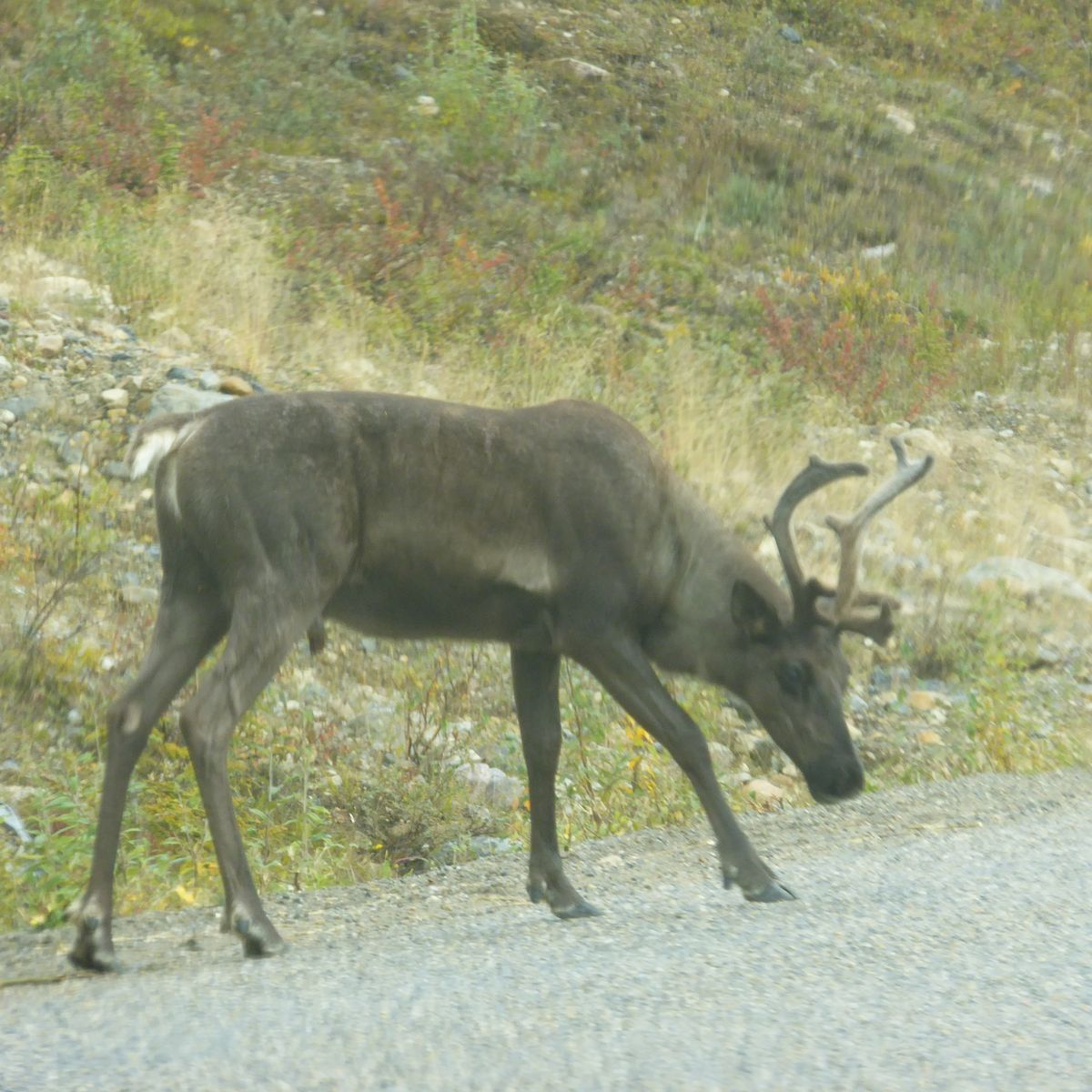
    It is estimated that over 95,000 caribou make Alaska their home, so it wasn't surprising that we saw a few of them.   They are an important part of Alaska's history and culture.   


    P1010516

      Archeological evidence shows that ten thousand years ago, nomadic hunters –descended from the people who first crossed the Bering Sea land bridge  – followed caribou trails into what is now Denali National Park.  The animals were hunted for their meat and fur.   Their  hollow hairs are a natural insulator against the cold weather.   

    Today, the caribou population is managed by controlled hunts as well as by predators (they are the center of the food chain).  Many Native Alaskans still depend on them for food and some areas along  migration routes (as they travel from summer to winter grazing areas) are set aside for subsistance hunting. 

      P1010547

     We saw a herd of several hundred on the Dalton Highway (past the Arctic Circle) and that was amazing.    (The picture above,  part of a much smaller herd of females and young, was taken in Denali Park.)  In the summer time,  the herds mostly consist of females and young with the males more often spotted alone.

      P1010514

    Both male and female grow antlers during the summer.    Bulls drop theirs after the Autumn mating season,  while cows carry theirs until mid-winter or even later. 

    Caribou and reindeer are  pretty much the same animal.   In Alaska, reindeer simply means domesticated caribou.    (According to the story told  by one of our Denali drivers this means that the reindeer pictured pulling Santa's sleigh are all females, since at Christmas time  males would be antler-less.)

      P1010551

    When the Alyeska Pipeline was being planned in the 1970s, there was worry that it would disrupt the caribou population (and, therefore, the entire ecosystem).  In places where it was known that the pipeline would cross the migratory paths, the pipeline was  buried to allow them to proceed unimpeded.  But it turned out that step was not necessary; the caribou simply ignore the pipeline, treating it as if it isn't even there.  They slide under the pipe wherever and whenever they want.     


    Linked to SATURDAY CRITTERS.  (Thank you to Eileen for hosting) and to NATURE NOTES with thanks to Michelle.


  • BRITISH COLUMBIA SURPRISES

    Checking in quickly from our RV Park home for the night — in Chetwynd British Columbia.      (We are slowly wending our way back to the USA …   this is the first time in days that we've had  WiFi access.)  

      P1020688

    Who knew there were American Bison in British Columbia?  We do now — after seeing three large herds of them earlier this week, plus a few stragglers here and there along the way.

    We saw all of these amazing animals a couple of days ago —   traveling the 200 miles between Watson Lake and the Toad River RV Park somewhere along the Alaska Highway (the part of it in Canada).   


    P1020677

    Of course there was a sudden downpour just as we saw this Mom and her baby — they were loving that clover and didn't let the rain dampen their enjoyment.  (But it sure played havoc with my camera.)

    Our Alaska summer ended with stays at Haines and Skagway  – both of which we enjoyed for very different reasons and both of which I will eventually blog about — along with  a few (hundred) other wonderful Alaska places that I haven't yet posted.    


    P1020717
    A family of Stone Sheep.   There was a whole herd enjoying the minerals in the soil in this particular spot.


    Although Alaska is behind us,  our camping adventure continues as we head south.  So many places, so much to see!  BC is beautiful.


    P1020743-001

    Caribou


    We still have quite a few miles to go before we cross Canada's southern   border…   and if we have many more amazing photo-op days like this one was, it could take a while!  


    P1020656

    Moose enjoying a late dinner


     Linking to Eileen's SATURDAY CRITTERS and (if I am able) next week's OUR WORLD on TUESDAY.  (Thanks to all of the hosts.)


  • VIEWS OF WRANGELL-ST ELIAS NATIONAL PARK

     We traveled along the scenic Copper River and its tributaries into Wrangell-Mt St Elias National Park.  When we came back after our stay, the RVs and the fish wheels in the background (below) were cut off from the road because of flooding.  I hope they eventually got out.  We had beautiful weather the first part of our stay, but on the last day we were in the Park, there was drenching rain.  

      P1020294-001


    While Wrangell-Mt St Elias is the largest National Park in the US, other than about 20 miles of bad road, it is roadless wilderness.  Backpacking wasn't on our agenda, so we didn't do any hiking into the glaciers.  But we had lovely views from our campsite, from the van we took into Kennicott/McCarthy, and as we walked around the  site of the old company town. 


    P1020222


    The Kennicott Glacier is hundreds of feet deep and is covered with a few feet of gravel.  It is retreating and causing some land that was along side to collapse.  


    P1020267


      P1020244This is a view of the Glacier from an empty (no glass)  window in one of the top floors of the Copper Mill (this post).  

     Back then, the glacier would have been much closer to the mill town buildings.

    But I don't suppose the people working in the mill had  time or the inclination to admire the view.    

    In fact, the story is that the company actually built their outhouses high above the glacier, so that the waste dropped right down onto the ice.  That's cold!  


    RV park at Kennicott

    Some morning views from where we camped while we were in the Park.  (It was called Root Glacier Base Camp).  The footbridge goes across the river where a van picks you up for the drive to the old town of McCarthy and on into Kennicott.

     We noticed while in camp that the fireweed was bloomed out clear up to the top. 

    RV park at Kennicott1-001


     Alaska folklore says that when this happens it is only six weeks until Winter (this post).  So we decided it must be about time to get ourselves down the Mountain!  


    SHARED with SCENIC WEEKENDS.  Thank you Gemma. and SKYWATCH FRIDAY , Thanks to Yogi and the SWF team.  (Maybe I will be last on both memes this week … WiFi where we are now isn't  quite as good as it was supposed to be.)

  • KENNICOTT WORLD HERITAGE SITE

    We took a rough unpaved road through part of Wrangell-St Elias National Park to the Kennicott Copper Mine World Heritage Site.        The mine-site, the Kennicott Company town, and the small old village  of McCarthy lie within the National Park.  Gold was first discovered near here during the Klondike Gold Rush, but it soon became evident that the rich copper deposits were far more valuable.  (The highlighted link here is a good overview of the history.)


    P1020295


    This narrow passage marks the end of the paved road.  From here it is 62 miles to McCarthy.  The road overlies the old railroad built to transport ore from the Copper Mine to a steamship port on the Alaska coast.

    The story is that the builder — in a hurry to get the railroad through to the new mine — put a case of beer on the far side of these rocky cliffs.  He told the crew they could have it when they blasted through the rocks– so they cut the minimal amount to clear the train.

      P1020206


    This single lane steel span-wood decked bridge, with low guard rails, replaced the wooden trestle across the Gilahina river.  The train ran from Cordova up the Copper River to Kennicott.


    P1020231


    This is the  copper ore mill building.  At 14 stories it is the tallest all-wood building in this country.

    We climbed pretty much the whole thing — on some very narrow, rickety stairs.  It was kind of amazing to me that people are actually allowed to tour this old mill. (We did have to sign waivers and wear hard hats in parts of this building.)

      P1020264

    Our guided tour of the entire old company town was excellent. It included the old company store,  several various shops, housing (barracks for the workers, fairly nice old homes for the bosses).   A pretty building that had served as a hotel/temporary housing has been renovated and restored and is again an inn with a nice restaurant. We ate lunch there. 


    I plan to link this post to next week's  OUR WORLD TUESDAY.  Thank you to the lovely ladies who host this great meme.


  • DENALI NATIONAL PARK

      P1010536


    Catching up on a part of our Alaska summer that I wasn't able to blog much about at the time.  Either because we were too busy, too tired, or there was no Internet.  Or all of the above.

    Dall sheep


    We stayed in Denali in mid-July.   Dall sheep were just one of the animals we saw there for the first time.

      P1010590-001

     The scenery all along the road was beautiful, even though we were not among the lucky one-third of Denali visitors who get to see Mt McKinley shining in the sun.   Clouds hung over these lower peaks  … and  raincoats were the costume of the day.    

    P1010578-001

     We stayed at Teklanika Campground while we were there.  At 29 miles up the road, it is the furthest place where you can drive a private vehicle.  From there we took the Park Service bus along the rest of the road through the Park.   

    It's a hop-on/hop-off, so at any time you can get off to spend some time exploring or hiking.  (Just hailing the next bus when you're ready to go further or go back to camp).


    The first day,  we took the bus straight through to the end of the trail at Kantishna, the site of a reconstructed miner's cabin from a brief gold rush in the early 1900s. 

      P1010556This ride was  an all-day excursion with several planned stops and frequent spontaneous ones for wildlife sightings.

    The second day, we rode just part of the way stopping for a while to explore and spend some time at the Visitor Center, which is about half-way up the road.

      All of our drivers were great about waiting for wildlife photo stops as long as they could stop in a safe place.

      P1010575This was the cause of one of those stops — and I was proud to be the first person on the bus to spot this grizzly guy and shout out.    

    It's kind of  funny to hear the shouts "bear on the left", "moose on the right", etc.  Sometimes you hear "oops, rock bear".  Once somebody yelled "mosquito in the bus".  

    More wild Denali animals in a future post.

    This weekend,  I am linking to SCENIC WEEKENDS (thank you to Gemma) and to SATURDAY CRITTERS (thanks to Eileen).