• GARDEN OF THE GODS

    Gog f vis ctrpic 55 In 1859 two surveyors exploring locations in Colorado came upon this beautiful area of sandstone formations.  One of them said "this would be a capital place for a beer garden."  The other one, who had a poetic turn of mind, said "Beer Garden?  Why, no, this is a place fit for the gods to assemble.  We will call it Garden of the Gods."  And so it has been called ever since.

    GOG 047 In 1879, the railroad magnate Charles Perkins purchased 240 acres of land here, at first thinking he would build a summer home.  He never did, deciding he would rather leave his wonderland in the natural state for all to enjoy.  He didn't leave any written plans for the area when he died in 1907, but  his children, knowing his feeling for the Garden, gave the 480 acres to the City of Colorado Springs.  They specified that it should forever remain free to the public and that the only buildings on it were to be those necessary for maintaining it as a public park.  (They also specified that there are to be no alcoholic beverages in the park, so that guy who wanted it to be a beer garden would still be out-of-luck.)  Climbers 025

    We went to Garden of the Gods in the late afternoon, after exploring Pikes Peak earlier in the day.  It had been cold and windy up there.  Here, the summer sunshine reflected on these beautiful red rocks made it seem even warmer than the 80 degrees it was.

    You really need to dress in layers in Colorado!


    G&L051 Geoff and Lisa at the Park Visitor Center.


  • PIKES PEAK, UNBUSTED

    PikespeakY007

    The switchback road to the summit of Pikes Peak is owned and kept up by the City of Colorado Springs.  It's a toll road.  We paid and then a few miles further up, we noticed a booth on the other side with a line of cars.  We wondered if the City charged again for coming down.  The down booth, it turned out, is a brake check.  If you're overheated, a guy tells you to pull over until the brakes cool down.  Geoff knows how to drive in the mountains and didn't ride his brakes, so we didn't get busted.  We thought going down the switchback curves was less scary than going up. 

    Pikespeak tl 022PikespeakY13

    It's not too hospitable an atmosphere up there above the treeline, so I'm pretty sure people would have paid to get back down if they'd had to!  Only 60% of the oxygen available at sea level, plus snow, thunderstorms in the afternoons (possibilities of hail, wind, and lightning any time of the year).  The temperature rarely goes above 40.  (I think it was a little warmer the day we were there, but it was quite windy.) Here you can see the afternoon black clouds rolling in. 

    Pikespeak05

    Here are some things we learned about this 14,115 foot mountain.

    • It isn't a National Park or monument.  A small upper portion was designated as a national historic landmark in 1961.    

    • It was discovered by explorer Zebulon Pike, but he never made it to the summit.  Someone named Edwin James was the first to do so (in 1820).  

    • Gold was discovered in the area in 1858 and "Pike's Peak or Bust" became the slogan of the Colorado gold rush. 

    • There is an annual car race called "Pikes Peak International Hill Climb".  (Only two of the people in our car cared a thing about this race.  They sat in the front seat.  They were father and son.   The other two of us thought that the sharp curves were quite treacherous enough at safe speeds.) 

    • A_T_B sign12

    Katherine Lee Bates, a professor from back east, thought of the words to the poem "America the Beautiful" while she enjoyed the majestic view from the top of Pikes Peak.  She had taken a train journey and seen other sights that she put into the poem (later set to music) but said that the words came together while she was here. 

    It was a fine day trip.  Beautiful scenery and good company.  We've always heard about Pikes Peak and we're glad we got to go to see it. 


  • ROCKY MOUNTAIN HIGH JUNE 2009

    Rocky op 09Our son and daughter-in-law moved to Longmont, Colorado about the same time we started our most-time (then Full-Time) RVing, so we've been coming to the Loveland-Longmont area once or twice a year for a decade.  By now, it is another place that feels like home and it's good to be back again.

    A week ago on Saturday, Geoff and Lisa picked us up for a day trip through magnificent Rocky Mountain National Park.  It was a beautiful day.  Sunshine, snow (but none on the roads), elk, and the closest we've ever come to a moose (mother and baby).   Scroll through the pictures — they really say it all. 

    Elk 12

    Moose and calf 20 Moose 021-1

    Elk meadow p15


    Yup, it's beautiful Colorado in June.  We're lucky to be "home."

  • OH FOOSH!

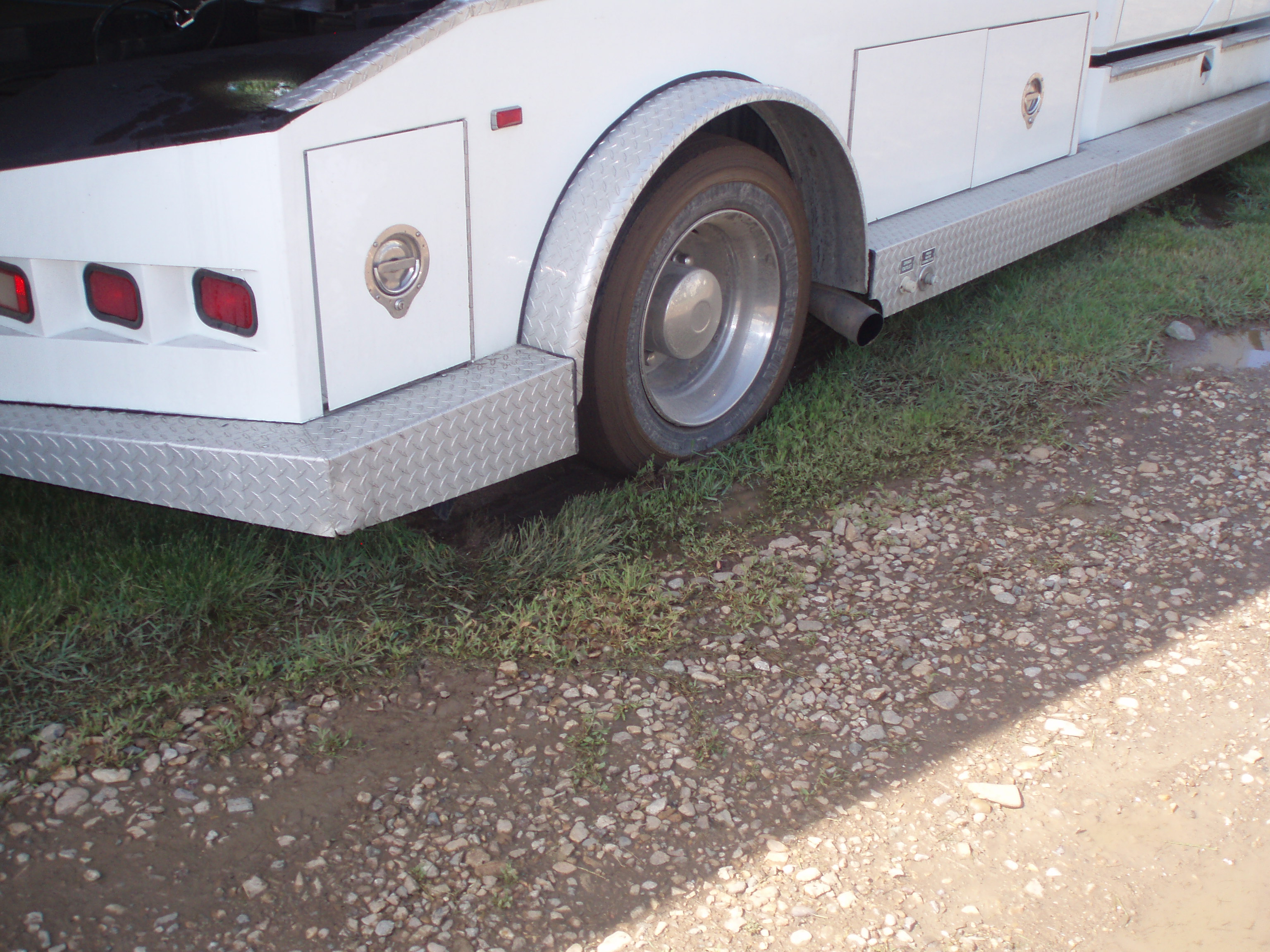
    Sinking 02 Here we are stuck in the muddy grass in Belle Fourche (the locals call it Belle, but the second part of it is pronounced Foosh).   Which is now my favorite euphemism when experiencing life's little problems.  The mid-west has had a terrible rainy spring and lots of problem due to flooding.  We have been incredibly fortunate in avoiding heavy weather.   Some rainy days, but none that kept us from seeing what we wanted to see.  So we realize that this really wasn't a big problem in the greater scheme of things.  Still it is is the kind of thing that makes you say Foosh!

    It was raining hard when we drove into our reserved campsite (never fun).  But also, and more importantly,  the ground was saturated and there was no gravel behind us.  There was a very large tree right on the corner of our space, which would make it impossible to turn right on the narrow road in front and a steep and muddy hill to the left. (So, it was a pull-through site going in, but we wouldn't be able to pull-through going out.)    The owner of the park, just a nice guy trying to make a go of it on his 15 acres, said he didn't have any other spaces where we'd fit.   He said we wouldn't have any trouble getting out in the morning…. "oh just give yourself plenty of time to warm up and go for it."  Then he added, "I know what these big trucks are like.  I've got one that's been stuck since February."    Yikes! 

    Of course, it rained hard all night long.   And the next morning, even though the sun was shining and it looked like a nice day, the ground was so wet that our feet whooshed in the mud when we walked.  And so, when Bill backed up to pull out, the truck sank too.  What a nice rut we made.

    Tow truck 004 We looked around for wood or gravel or anything that we could use for traction, and gave it a few tries, but no luck.  So it was a 'Thank God for Towing Insurance' moment.  When the truck arrived, it was really just a small pickup.  But the driver (who was dressed like a CPA on casual Friday) was kind of a tow-guy genius.  He just attached a couple of winches to the truck and a couple of trees and stood there and watched them pull Bill right out.  He said he was called out to this park all the time.  They really need to buy some gravel! 

    Muddy knee 05 So we drove on down the road.  Bill was so happy to leave that he didn't even want to take time to change his muddy clothes.  (We don't ever exactly dress up for our road trips, but this is the first time he's ever driven with mud on his knees!)

    Spearfish. waterfall _0433 The day wasn't a total loss.  Just a few minutes out of Belle, we drove through the town of SpearFish and then through beautiful Spear Fish Canyon.  The Canyon is one of the loveliest drives ever.   The picture is from our 2004 road trip when we stayed in Sturgis and spent quite a bit of time exploring the area.   We didn't stop this time, but it's pretty from the road too. 

    So then we spent a night in Whyoming (Ft Laramie) — and then on to beautiful Colorado.  

    After all, you can't fully appreciate nature's grandeur without a few Oh Foosh moments.


  • NORTH DAKOTA RECORD-HOLDERS

    We enjoyed North Dakota and hope to come back someday, because we missed a lot on this short stay.  But there is an awful lot of green, flat farm country to cover between places.  Pretty to look at this time of year, up to a point, when it starts to feel "more of the same."  Here are some of the things North Dakotans have done to break up the monotony.

    Lgst buffalo jamestown We stayed one night in Jamestown.  The RV Park, called Frontier Fort, was within walking distance of  (Ta-Da) THE WORLD'S LARGEST BUFFALO.  There's also a Buffalo Museum and an old-western town reproduction.  One of the buildings in it is dedicated to Louis L'Amour, the prolific writer of Westerns, who was born in Jamestown.   As a boy, he spent a lot of time in the Jamestown public library and he credited the librarians with forming his ambition to become a writer.  

    Frontier Fort was a good place to stay overnight.  The RV park was fine and the attached fort and village area made for an interesting afternoon walk after we got settled in for the night.

    New salem sue Just down the road apiece is this statue of New Salem Sue (Ta-Da) THE WORLD'S LARGEST HOLSTEIN.  Apparently, she is anatomically correct, but we only saw her on the brink of the hill because we didn't stop at New Salem.  Sue


    Near the town of Steele, we also passed (double Ta-Da) THE WORLD'S LARGEST SANDHILL CRANE.

    Lg sandhill, steele nd It is green and pretty here in North Dakota this time of the year, but creating these road-side record-breakers probably gives people something to do during the long Winters.  (There are snow fences and snow gates on the highway, snow markers in the towns; we wouldn't want to be here when they were in use!). 

    Everybody seems to make fun of North Dakota (including us, evidently) but we actually really did enjoy our time here.   We didn't even have enough time to see all of the Theodore Roosevelt National Park and so, for that alone, we'd like to come back someday.  And then, too, we could check on the welfare of all these large animals! 

  • THEODORE ROOSEVELT NATIONAL PARK


     At this point in time, our Spring road trip is winding down and we're ready to get back to places that feel like home and people we miss.  As a result, we really didn't give ourselves enough time to thoroughly explore Theodore Roosevelt National Park.  But we loved what we did see.  The entry to the South unit of the Park was about 30 miles from where we were staying in Dickenson.  When we got within a couple miles of the entry, the terrain changed from the gentle, flat farmland that is most of the State of North Dakota to beautiful rocky formations and chasms.  The Missouri River did a pretty darn good job of carving here.

    We took some easy hikes and saw some beautiful scenery.  Painted canyon 91 This is a view of Painted Canyon just on the Park's edge, near the town of Medora.   In the distance are the North Dakota badlands.  (The South Dakota Badlands are another National Park.)  We took a short trail hike here.

    We also stopped at several other places for short hikes. This Park has the clearest air of all the National Parks.  (I wonder if this might not be true of the whole State of North Dakota as well.  Not too many people and not too much industry here.)  


    Hill top y 19 


    Prairie dogs pic 104 We saw some wildlife.  There are quite a few prairie dog villages and  several herds of wild feral horses whose ancestors have roamed these lands for centuries.  (The one below is standing in the Little Missouri river bottomland.) 

    Feral horse little mo 129

    We also saw quite a few bison.  (But nothing like what we saw last year at Custer State Park, in ND's neighbor to the South.)  (Click on the blue if you love bison/buffalo pictures as much as we do!)

    We learned some history.

    TR cabin 99 This is the cabin where Teddy Roosevelt lived during his time in North Dakota.  The cabin has been moved to the Park's main visitor center from its original location, the Elkhorn Ranch unit of the park, which is less accessible. When he lived at the Elkhorn, Teddy led a simple rancher's life.  He learned about the badlands and nature and let the beauty and quiet of the area heal him from the recent death of his wife and mother at their home in New York.   Roosevelt came to North Dakota to recover.  He said later that he would never have been President if not for the time he had spent in North Dakota.  As President, TR was instrumental in establishing National Park legislation.  He wanted all Americans to experience some of what he felt about these beautiful spaces.

     Truck hill y 21

    We are always happy when we can see another one of our National Parks and we'd like to explore this one again sometime.


  • ENCHANTED HIGHWAY

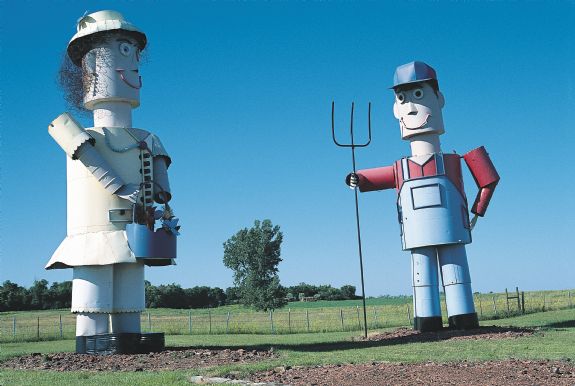
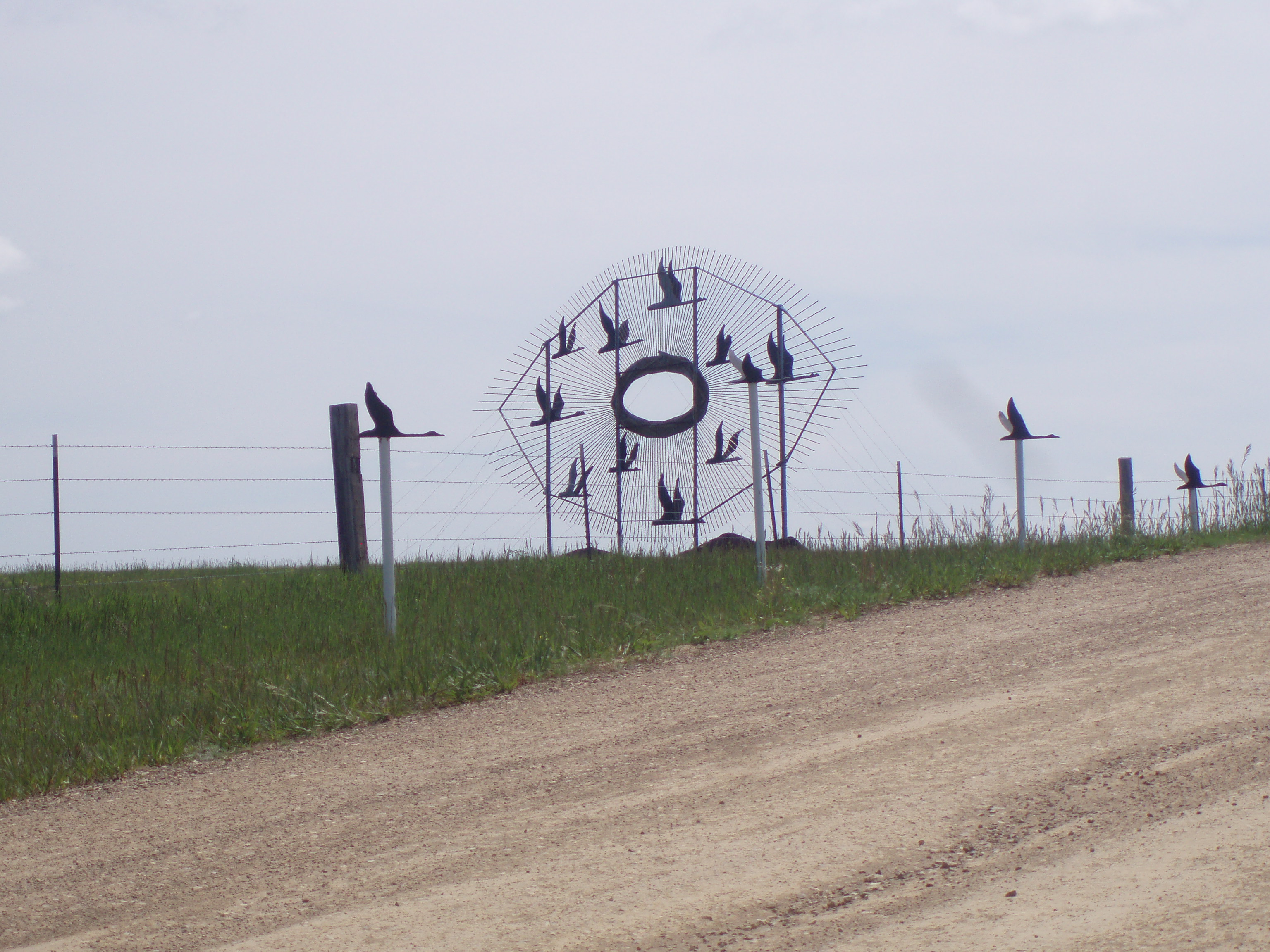
    The Enchanted Highway is a 32-mile scenic drive a few miles south of Dickenson, North Dakota.  Ench hwy geese 71

    The seven folk-art metal sculptures at stops along the Highway were designed by Regent native Gary Greff, and built with the help of area farmers.  They celebrate and honor North Dakota nature and history. 

    Greff hoped his creations would draw tourists and help to revive Regent, which (like many other midwest farming towns) has definitely seen better days. 

    Enchanted hwygeese 67 Greff has no formal art training.  All of the sculptures are built from scrap metal and old farm equipment.   The first sculpture (the Tin Family) was erected in 1991 and the seventh and last (to date) in 2001.  That one is Geese in Flight, which can be spotted from the Highway.  It is made out of used oil well pipe and oil tanks, and weighs 75 tons.  The largest goose is 19 feet long.  There are about fifty individual geese perched on each post leading up the side road to the pull-off. 

    Ench hwy fish sallie 76 Our favorite stop was Fisherman's Dream.  (That's me standing beneath it, feeling small.)  This one is three dimensional and shows seven North Dakota fish.    The rainbow trout is 70 feet long. 

    We took the highway on in to Regent.  It doesn't really look as if it is thriving, so I'm not sure if the hope of reviving the town has been realized.  But we were there on a Sunday afternoon and it was very quiet — maybe on a Saturday in the middle of the summer it looks more lively.  Maybe.  But in any case, if you're in the area to see the National Park or for any other reason, the sculptures are definitely worth the drive.  They do get visitors from all over the world. 

    We looked in the Enchanted Highway gift shop and saw drawings of future plans for the highway and the town.  We wish them luck.   We didn't take pictures at all the stops, but you can see all of the sculptures here:  http://www.enchantedhighway.net


  • BE GRATEFUL

    Be grateful We've seen this roadside sign in a couple of places since we've been in the mid-west this time.  I'm not usually a fan of billboards, but I liked this one this because we do have so much to be grateful about. 

    But sometimes the drive between places can get boring, so it's good to be reminded of how fortunate we are to be able to enjoy this lifestyle. 

    We are on the road.  Grateful that we're heading to our next adventure and for all we've seen already and all we've learned along the way .


  • SPRING GARDENING – the RV Way

    Lilac 041 This is the first time in several years that we've seen typical Spring flowers.  They're usually gone by the time we get back to Colorado and Oregon, but by traveling the  Northern route this time, we've   followed spring (with a few days feeling like a return to winter).  It was especially lovely to see — and smell — lilacs.   These are in Duluth — in June, which I think is later than when they bloom in the Northwest.  

    So now that Spring is almost over, here's a little more gardening the RV way.  No mess, no work, just pure enjoyment.  Somebody has to appreciate all the work other people do!

    These pictures below are from the Japanese Garden at House on the Rock, near Spring Green, Wisconsin.  A group of Buddhist (I think) monks were touring at the same time as we were.  They seemed to enjoy it.

    Japanese garden from above 26

    Garden - monk66

    Fuschia bskt 58

     Large strawberryflower pot71 More from House in the Rock


    Flowers bemedji62

    Bemedji, MN


    Here are some from other gardens, other Springs.

    Japaneses iris denver bot 17

    Iris, Denver Botanical Garden


    Garden willows 06

    Water Lilies, Chinese Garden, PortlandPink lily and koi pond 15

  • DULUTH, TWO HARBORS, AND LAKE SUPERIOR

    I wasn't very happy with Minnesota the afternoon we first arrived.  It was raining HARD and it was cold — upper  40s.   We'd had that one hard rain in South Carolina, but that was just inconvenient.  This was miserable.  But the weather improved the next day and we both ended up really enjoying our short stay in Duluth. 

    Bridge24 On this road trip, every place we stayed up until Duluth had been out in the country.  Here, the travel-planner opted for a city spot and that worked out beautifully.  We were at a marina with RV spots, nearly under the famous Aerial LIft Bridge and within walking distance of the city center. 

    So we were right on Lake Superior, which is stunning.   I guess I've always known that it was the biggest Great Lake, but before this visit I really didn't understand what that meant.  It's a fresh-water sea really.    

    Lighthouse2hrbrs14 The second day, when it was a little warmer and much drier, we drove along the Skyline trail to the town of Two Harbors on Agate Bay.  Beautiful views and lovely place to walk.  This 1892 lighthouse is still operating.  


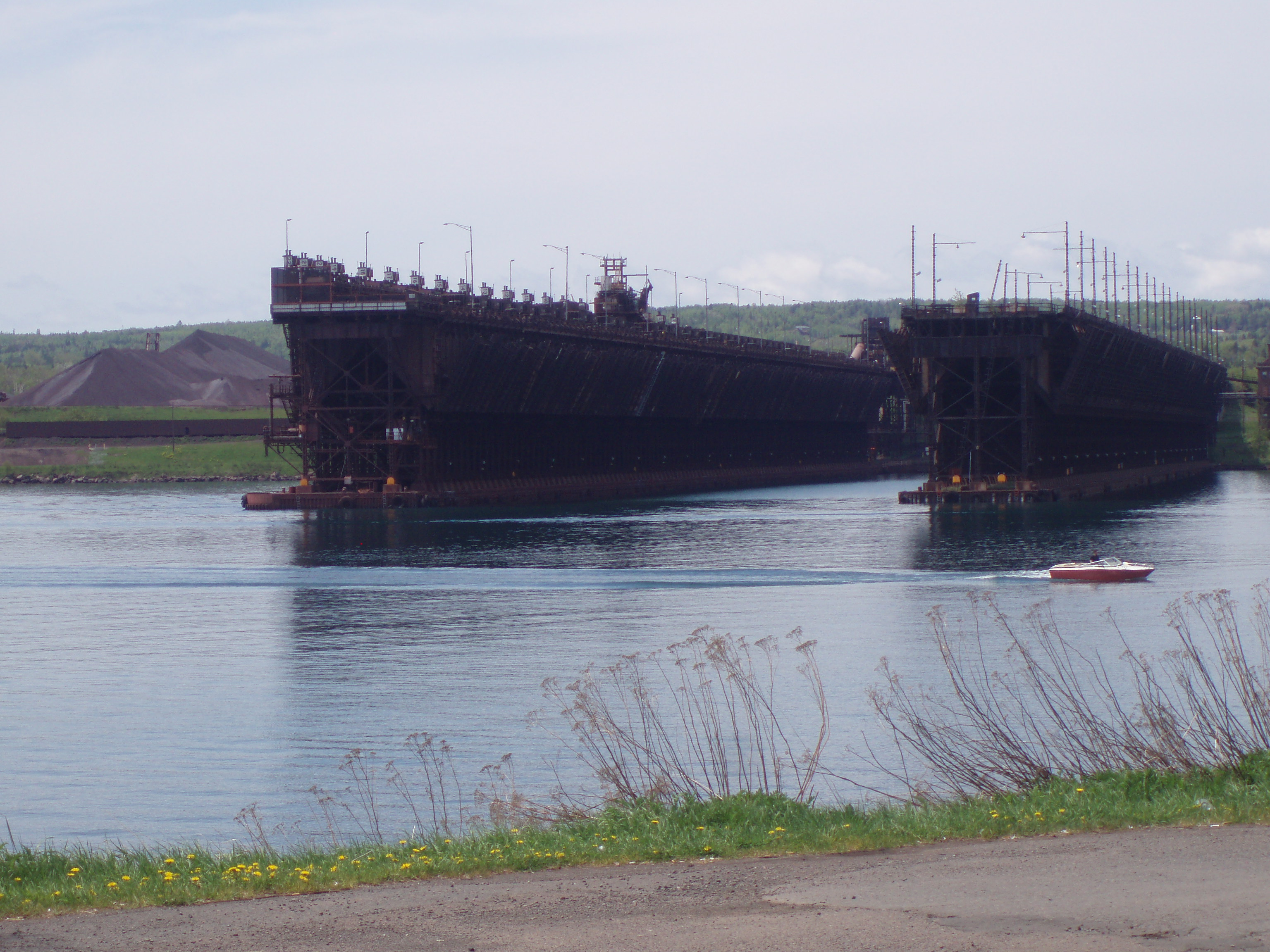
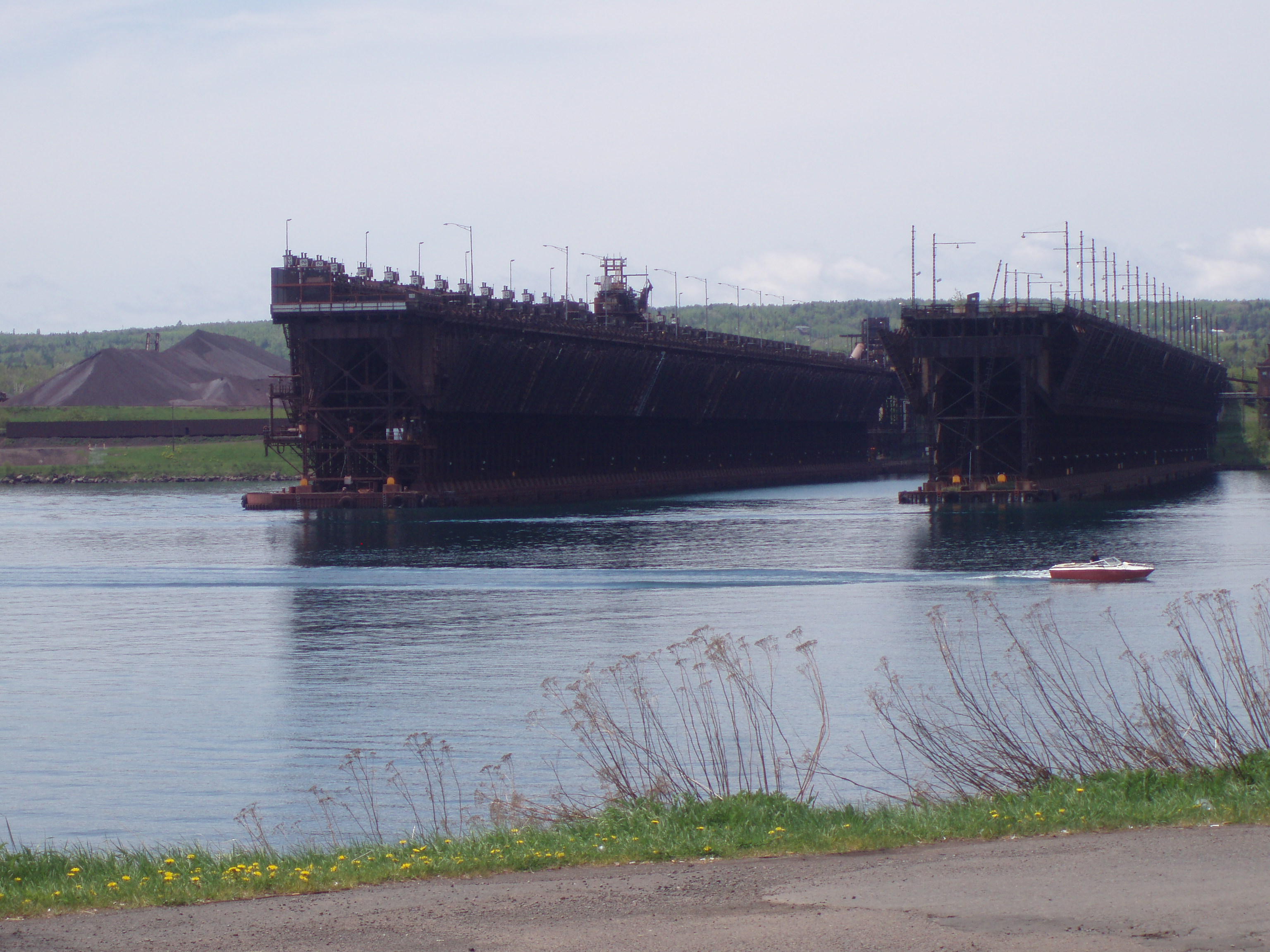
    The huge loading docks at Two Harbors (below) are ready to load taconite (a pelletized iron ore) onto 1000 ft. boats. The other picture is the Lake Shore.  


    Ore ships 06


    Lake sup shore19


    Duluth 33 The next day, we did walk across the bridge — briskly!  (The sun was shining, but it was a little chilly for bones that are still used to Florida spring temperatures.)  We had to wait while the bridge rose for some big boats.  We didn't see any freighter ships pass through it.  Not as many of them are operating these days because of the economy.  But we picked up a copy of the daily "Shipping News."  (I didn't know there really was such a publication.) And it listed 15 transport ships that would be in on this day.

    William A Irvin ship 47 We visited the cargo ship William A Irwin. Built in 1938, the Irwin was the flagship of US Steel's cargo fleet.  It's a floating museum now, replaced in late 1970s by bigger and faster vessels.  We had a private tour (only because there aren't very many tourists here yet).  Our guide was a retired second generation mariner employee of the shipping company. We got a great history lesson about shipping and about the Lake and had time to get all of our questions answered.  

    Porthole 45 The pilot house is 80 feet above the water, providing a spectacular view of the port city.    Inside, we saw the loading areas and holds, engine and communications rooms, both with equipment still intact, furnished crew and officer quarters, and, suprisingly, guest quarters.  As the flagship, she carried US Steel bigwigs on inspections or just slow and relaxing lake cruises.  The 600+foot vessel traveled at 12 miles per hour. 

    Duluth has great canal and lake-front paths, lots of restaurants right on the water and lovely old brick buildings.  Even in this brisk weather, this old part of town was alive and vibrant.  Of course, to the locals — office workers walking on their lunch hour or after work — this was spring weather.  We were just about the only wimps in winter coats.

    There are many other points of interest here that we didn't have time to see. So we would love to come back to Duluth another time — maybe later in the summer though.  (Of course everybody is assuring us that Minnesota is much colder for June than usual.  It's kind of like going to a fishing spot, where they always were biting last week!).