Category: Florida

  • WALK OF THE WEEK – Eco Preserve


     Our (board)walk of the week was at Four-Mile Cove Eco Preserve in Cape Coral.   Here are some moods of the evening sky on that day.


    2017-04-03


     We saw the usual birds at the preserve — Great Blue Herons, Ibis, Egrets, all those crows enjoying the air currents, but nothing super exciting.  (All birds are fun to watch, but we saw nothing that I haven't already posted several times.) 

    Instead, the best birds we saw were  along a city street on our way there.  I've probably already shown a million pictures of burrowing owls too, but the cuteness factor is so darn high, I never tire of looking at  … and  showing off … these babies. 


    DSCN1641-001


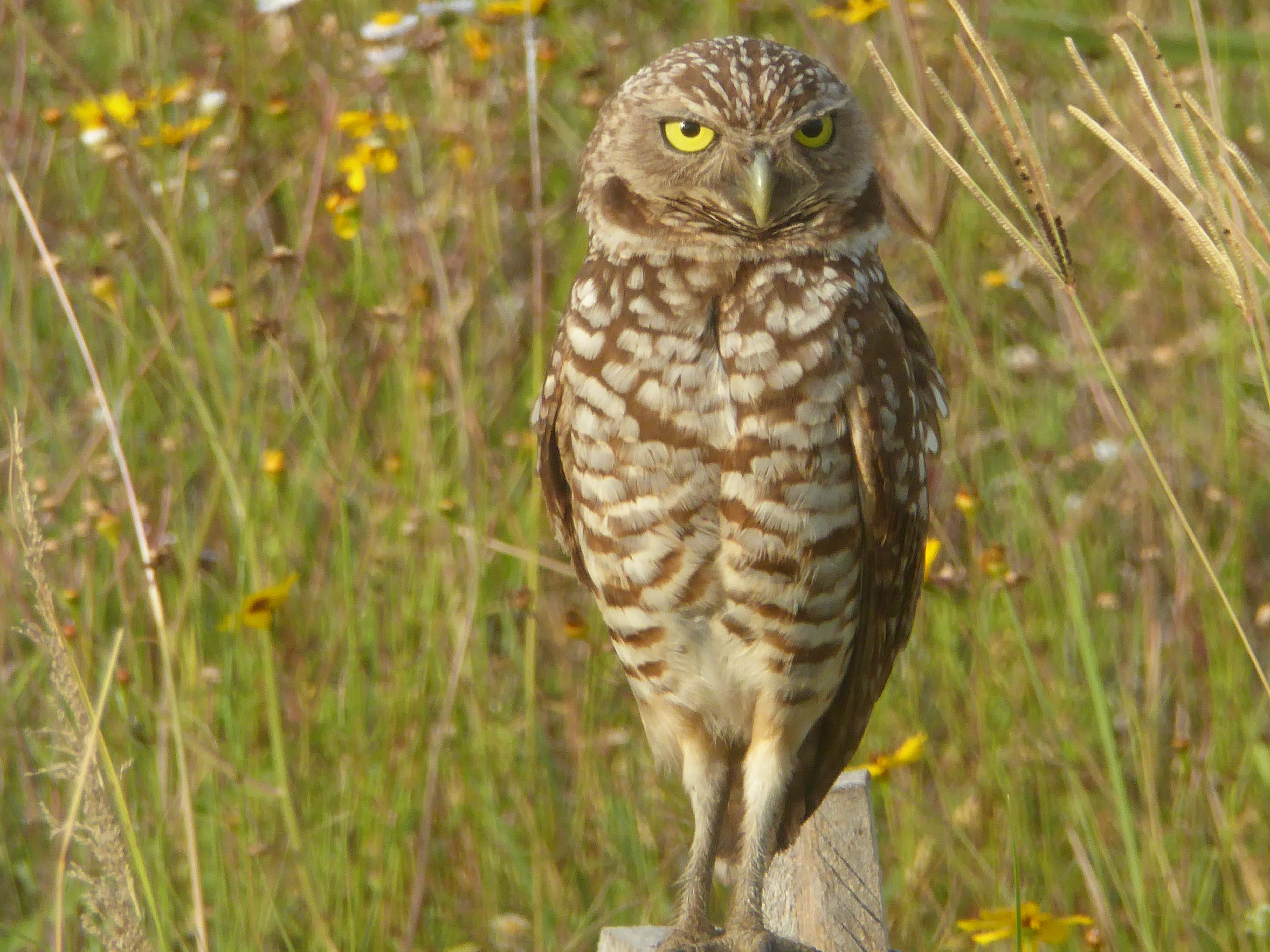
    An adult burrowing owl kept watch from a stake put up for her convenience.    It's pretty easy to spot owl burrows —  these stakes and the white pipe mark the safety  zones for these honored residents of the Cape. 


    DSCN1632-001


    Above is a closer look at the owlets (zoomed in — I didn't get any closer to the burrow).    Last year, I had a comment from a woman known as Cape Coral's Owl Lady, explaining that the dark-eyed ones are a mutation due to inbreeding.   (These owls don't migrate.  As the Owl Lady said, the Cape Coral owls like it here in Florida and don't want to go anywhere else.)   Three of this group of siblings had the more typical yellow eyes.  

    While I was watching,  all of a sudden the one on the left slipped into the burrow  – it  looked like it just kind of disappeared into the ground.


    DSCN1656-001

    And then there were three.

    The rest were soon to follow one-by-one.  It must have been their bedtime.


    Following is a bonus left over from one of our excursions last month.   Too bad there's no way to enjoy  the delicious aroma of orange blossoms as we look at the pictures.

    2017-04-031


    Nearly all oranges grown in Florida are Valencias — mostly used for juice.    They taste fine, but they're harder to peel than navels and other eating varieties.   Different from other varieties of oranges (and, I think, most fruit trees) blossoms and fruit grow on Valencia trees at the same time.  A real win-win…. tasty fruit and wonderfully scented flowers all at the same time.    


    Linking to the following sharing opportunities:  

    SKYWATCH FRIDAY; SCENIC WEEKENDS; SATURDAY CRITTERS;  RATHER B' BIRDING;  ALL SEASONS; MOSAIC MONDAY; NATURE NOTES; OUR WORLD on Tuesday; FLORAL BLISS; and WILD BIRD WEDNESDAY.


    Thank you to all of the generous hosts.


  • SPRINGTIME IN SW FLORIDA

    Happy Spring!      It has been busy lately around the Canal Cottage but the kind of busy filled with mostly non-photo opportunities.    These are all memories from earlier this month.   Sharing with SATURDAY CRITTERS; RATHER B' BIRDING; ALL SEASONS; MACRO MONDAY;  MOSAIC MONDAY; NATURE NOTES; OUR WORLD On Tuesday; WILD BIRD WEDNESDAY and FLORAL BLISS.  Thank you to all of the hosts.


    IMG_0520-001


    We noticed several of these flowering plants around the owner's home when we visited Pine Island Botanicals on our recent farm tour.   The green part looked exactly like a cut-leaf philodendron, which were popular as house plants where we used to live (although I never saw them flower like this).   At any rate, although it looked like it should be a house plant, it was growing rampantly outdoors.     In fact,  the owner casually mentioned that this pretty plant was a pest that he was trying  to eradicate.    Just another example of  how different things are here in SW Florida.


    DSCN1559-001


    I had time on a recent shopping day to stop by the Eagle Pasture.   The eaglet (called E-9) had branched on March 6  (meaning he could kind of hop /fly out of the nest onto nearby branches.)    But early on March 14, just a few days before I was there, this  big baby did what the eagle experts called 'an accidental fledge'.  Really what that meant is that, for all intents and purposes, while he was showing off his new skills by balancing on the edge of the nest, he fell  to the ground.   At that time, he had not yet really flown.  So Junior spent a night on the ground (the parents brought food) and the next day they enticed him to fly up — he landed on a nearby snag and then that evening finally flew back home to the nest.  That's learning to fly the hard way!


    DSCN1553-001


    So on this particular morning when I got to the pasture I spied E-9 on this branch just above the nest.   I spent about an hour in the churchyard, watching and chatting with the people who watch the nest all day.  I hoped to get a picture of him flying or of the parents flying in — but E-9 was the only one home (or anywhere within sight).  And the whole time I was there, he did not budge from his spot on this branch…. he barely turned his head.  

    DSCN1583-001


    I imagined mom and dad leaving for their day of hunting and saying "Don't you dare go anywhere but the front porch while we're at work.  I mean it.  If you try that falling trick one more time, we won't feed you again."  

    Well, it could have happened this way, don't you think?   He sure didn't move.  Anthropomorphising aside, it was most interesting to see how the eagle parents just went on to the next step in training their offspring.  They didn't let E-9's little mishap scare them from keeping on their schedule of teaching him how to be an independent adult.

     * Disclaimers:  There's really no way to tell whether an eaglet is male or female.  It's just whatever people choose to think.    You may draw your own conclusions.  

    All of the information about the accidental fledge came from those people who watch every day and post to Facebook or to the webcam, which you can watch here.  


       2017-03-181


    This Spring flower 'collection' came from the various farms we visited on our recent tour.   The purple orchid was for sale at the tropical plant nursery. All of the other plants were growing casually here and there on the properties.    

    Many of our snowbird neighbors and friends are leaving Florida this week, heading to their Northern homes — some of them come earlier in the Fall than we do and some only spend the winter  (January through March) here in warmer climes.    But early Spring is hay-fever season in Oregon, so we aren't thinking of going home any time real soon …  and besides that,  it's a beautiful — and less crowded —  time of the year here in SW Florida.  It's a different kind of Spring, but a good one.


  • FOOD — FOR THE BODY, MIND, AND SPIRIT


    IMG_0509-001


    We don't have typical spring flowers here in SW Florida, but for a short time in late March, we see glorious yellow blossoms on the tabebula trees all over the area. Just like the daffodils and tulips I remember from Oregon, these blossoms can be quite short-lived.   A windy day can quickly blow every flower to the ground.  We caught this tree at its peak while we were on a Farm Tour on Pine Island.  


    2017-03-182


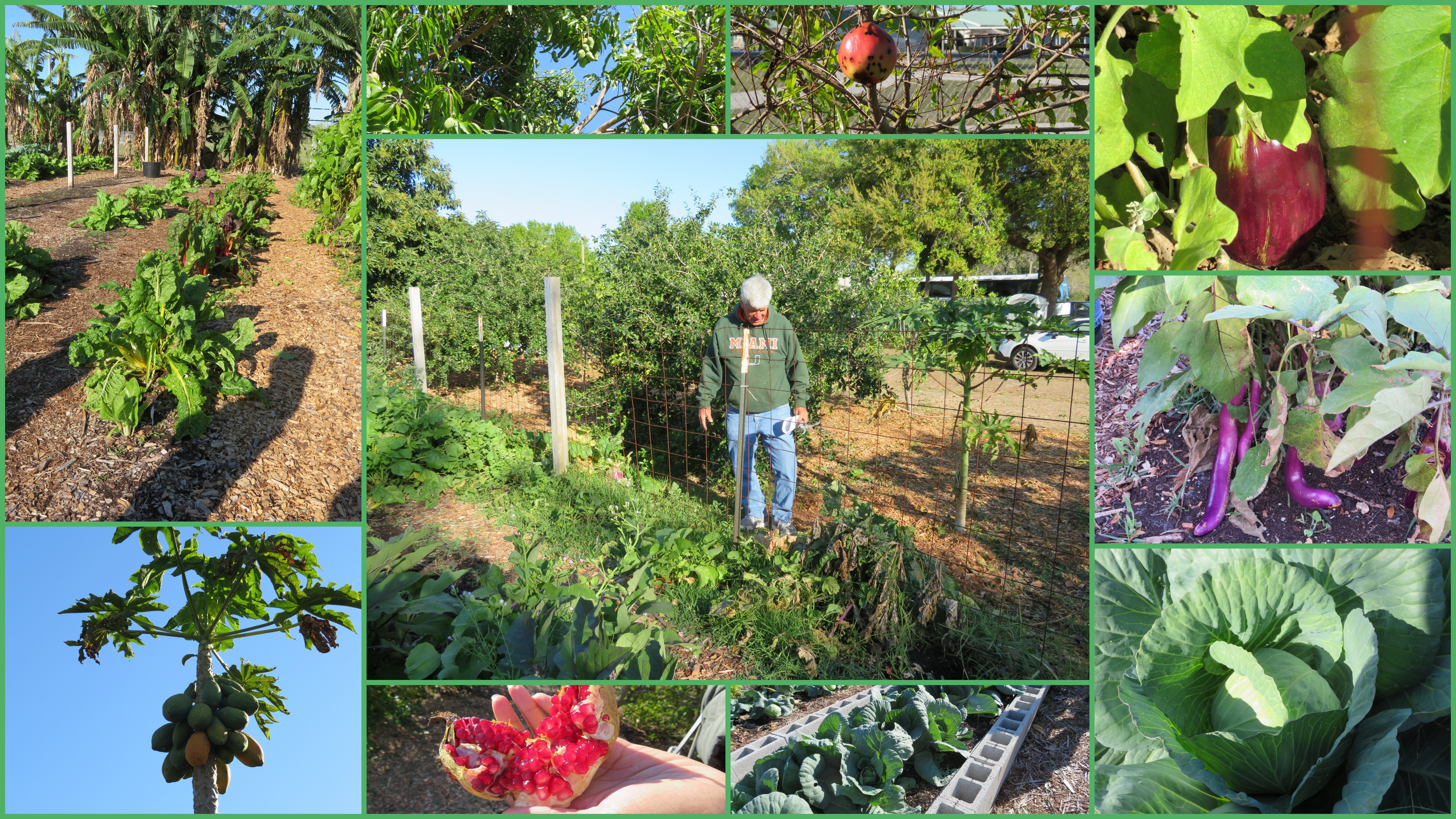
    We visited three non-traditional farms on our tour.   Our first stop, above, was Trafalgar Middle School's Garden in Cape Coral.   These students and their teacher (in the middle photo) have made a huge success of their small farm built on a former football field.  They have donated over 10 tons of vegetables and fruit to local soup kitchens.  They also provide produce to their own school cafeteria and culinary arts classes.  The teacher said that the students will try anything if they know it came from their own garden.   What a win-win deal!

    They grow garden crops including tomatoes, lettuce, a couple kinds of eggplant, collards, cucumbers, squash, beets, mustard greens, kale, parsnips, turnips, and cabbage. They have built a hydroponic garden for salad greens and herbs.  They grow flowers which they donate to local nursing homes.   Fruit trees include papayas, mangoes, persimmons, bananas, Barbados cherry, kumquat, limes, lemons, star fruit, moringa, avocado, jackfruit, and pomegranate.  

     The fruit trees were provided by FruitScapes, a tropical fruit farm that we also visited later in the tour, but where I got no good pictures.)


       2017-03-185


    I got a little side-tracked during our lunch stop tour.   Just had to take some pictures of this Osprey protecting his own fish meal.    He's  in a gumbo limbo tree in front of a barn roof.  This tree is known as the "tourist tree" because it resembles the sunburned and peeling skin of tourists who forget their SPF protection while vacationing under the Florida sun.


    IMG_0461-001


    A few of our friends and some perfect strangers who were on the bus tour with us — not a great picture, but included to show that last Wednesday was a cold day for SW Florida.  (With apologies to all of you  'up North' who actually had a second winter about the same time  – we caught the tail end of the March cold spell with day-time temperatures in the low 60s, which is chilly for us.) 


    2017-03-186


    Today, natural, raw, and local foods have become mainstream.   Michael and Chris,  who own and run the four-acre farm called Pine Island Botanicals, make a point of raising everything organically — using no artificial fertilizers or sprays and not wasting anything.     While Michael runs the outside gardens and hydroponic greenhouses, Chris (known as the Sprout Queen) has developed a business based on raw foods and juicing.   Back in the day, I used to grow a few alfalfa sprouts in jars in our kitchen cupboard.  But I'd never seen as many kinds of sprouted foods as Chris grew.   It was fun to taste … and kind of made me want to grow a few again myself (but only kind-of).


    IMG_0495-001These Extension Service-Sponsored tours are a great deal.  

    We learn a lot about the area where we spend part of our year.  

    And of course we do love to eat — and  so it's fun to learn about how our food is grown and about new foods to try.      


     Linking this week to these sharing sites, with thanks to all of the hosts.

    OUR WORLD TUESDAY; MOSAIC MONDAY; NATURE NOTES;

    ALL SEASONS; WILD BIRD WEDNESDAY; and SIGNS SIGNS.   


  • MARCH MUSINGS


    IMG_0440-001


    "Everybody needs beauty as well as bread,
     places to play in and pray in,
    where nature may heal and cheer 
    and give strength to body and soul alike."
     
    John Muir


    IMG_0418-001


    "Beauty is in the eye of the beholder." 

     (Multiple Sources)

    IMG_0419-001

    "Unless someone like you cares a whole awful lot, nothing is going to get better. It's not".

    Dr. Seuss, author and illustrator 


    2017-02-232


    "Here is a thought to keep in mind during all of 2017:

    It is possible to live in terrible, even frightening political times and still delight in the pleasures great and small of day-to-day life."

    Ronni Bennett "As Time Goes By".


    IMG_0441-001


    It is horrifying that we have to fight our own government to save the environment. –

    Ansel Adams, photographer (1902-1984)  


    No original words but all pictures are my own taken in late February/early March.   Skies are from a neighborhood morning walk, wood storks from Peace River near Arcadia; and all mosaic pictures from Lakes Park, Fort Myers. 


     Linking to: SKYWATCH FRIDAY; SCENIC WEEKENDS; ALL SEASONS; SATURDAY CRITTERS; RATHER B' BIRDING; NATURE NOTES; MOSAIC MONDAY; OUR WORLD on TUESDAY; and WILD BIRD WEDNESDAY.  Thank you to all of the hosts. 


  • WILD IN FLORIDA


    We went  with friends for a short tour-boat ride on the Peace River.   The sign below was posted on the dock where we boarded.  And of course we did pass several gators as we boated along.  I guess they weren't hungry, because none of them showed the slightest bit of interest in the boat or the people on it.  


    2017-03-02


    Other than the ubiquitous alligators, the rest of the wildlife in this post is all birds all the time.   And all are from a "land cruise"  (otherwise known as a Saturday Drive) to Lake Trafford, near Immokalee.


    DSCN1366-001


    Most of the birds I took pictures of were in the wetlands near a runoff canal to the Lake.  I think this is a juvenile Snowy Egret — he posed just beautifully for the camera.  (All pictures will enlarge with a click.)


    DSCN1393-001 DSCN1399-001


    A group of Ibis watched this Great Blue Heron forage.  They looked as if they hadn't been invited to the banquet.  When the Heron finished, the Ibis slowly began to hunt the waters themselves  – perhaps for whatever the Heron stirred up.


    DSCN1338-001


    This is a little out-of-order.  We saw several Caracaras on Church Road near Felda on our way to the Lake.  This was the only picture I was able to get because we had to find a place to turn around and get off of the road first.   The caracara is Mexico's national bird and is sometimes known here as the Mexican Eagle.  This one is perched in the same kind of tree (a slash pine) as the one where  the Bald Eagles (the US national bird) have a nest near us.  


    DSCN1494-002


    Pretty Little Blue Heron


    2017-03-04


    A few more of the usual suspects near Lake Trafford.   The Little Blue doing a wing stretch; another Egret;  juvenile Ibis fishing;  and a  Common Gallinule (marsh hen).


    It was a lovely day drive — the park at Lake Trafford, which is in Collier County,  was being well used.  There were families and kids fishing,  picnicing and birding, but it wasn't as crowded as places nearer to Fort Myers can get on weekends during the season.    We enjoyed our day.


     Linking to:   ALL SEASONS; MOSAIC MONDAY; NATURE NOTES; OUR WORLD on Tuesday; WILD BIRD WEDNESDAY; WEDNESDAY WATERS; and SIGNS SIGNS.  Thank you to all of the hosts.


  • FEBRUARY BIRDS


        DSCN1199-002

    This is  E-9, the local Eaglet  – 56 days old and almost  as big as its parents.  And almost ready to hop out of the nest.

    When it first leaves the nest, the eaglet will spend several days doing short test flights  to a nearby perch in the same tree and then returning  to the safety of home.  (This is called branching).    The parents will still bring food to the nest during this stage, because it will be a while before the eaglet is able to fly far enough to catch its own food.  These days, there are always a lot of photographers at the Pasture or at the churchyard next to it .  Everybody wants the perfect first branching picture.    


    2017-02-252


     Here's dad (at least according to one of the other watchers — I have never learned to tell the male and female apart).   He was on watch duty on Saturday morning when I stopped by– keeping an eye on Junior in the nest below and possibly modeling branching behavior for it.


    2017-02-251


     I was happy to see this Kestrel Hawk occupying the same snag where  I photographed  him a couple of weeks ago, the last time I stopped at the pasture.  Not only because I got better pictures  but also because I mis-identified it before and this gives me a chance to correct my error and thank the birders who helped me get it right.


    We went for a nature walk at Lakes Regional Park one day last week.  The Anhinga below wasn't the prettiest bird we saw that morning, but it was very interesting watching it work for its dinner:


    2017-02-23


    We saw it dive for that fish and then perform quite a dance spearing it and tossing it to keep a good hold on it, all the while swimming for shore, where it may have had a nest.


      DSCN1125-001


     It doesn't show up very well against that old log, but the fish is still in its beak in the above picture.   

    Anhinga drying wings better-002


    This is the way we usually see these birds  … perched on a log, drying out their wings.   Anhingas don't have natural oils in their feathers, the way ducks and most water birds do, so they have to air dry them.


    Linking this week to SATURDAY CRITTERS; OUR WORLD; ALL SEASONS; MOSAIC MONDAY; NATURE NOTES; WILD BIRD WEDNESDAY; and WEDNESDAY WATERS;  Thank you to all of the gracious and generous hosts.

  • A LITTLE SOUTH OF NORMAL


    Saturday afternoon, we were sitting on the open-on-three-sides porch at a brew pub in Cape Coral — quite comfortably enjoying the light breeze as we perused the lunch menu  …. when suddenly a waiter appeared and began lighting portable heaters near each table.   I snapped the weather app picture just as the flame went on.   


    2017-02-18


    In Oregon, 75 (F) is a normal summer day.  In Southwest Florida apparently it's a cold day in February.   Definitely a little south of normal here.


    Cape Coral (our next-door city) is a great place to find burrowing owls.   Here are just a few.     These aren't normal owls either — they are out and about in the daytime making them much easier to find and photograph.

                                                                                                                                                                                                                                                                                                                                                                                                                                                                                                                                                                                 P1030703-001

    P1030697-001

    P1030692-001


      P1030708


    ————————————————————–

    Earlier in the week, we went on an urban farm tour.   Here's a quick collage of one of the farms we visited:


    2017-02-015


    Borage, basil and other herbs, dozens of varieties of lettuce, Swiss Chard, beans, peppers, tomatoes and more were growing in profusion on this small organic farm.   That's not normal for most of the US this month, but it is here — it's the height of the growing season here in sub-tropical SW Florida.


    All of the produce above was being grown for a farm-to-table restaurant in this renovated hotel in Bonita Springs.


      IMG_0349-002


    On Sunday evening, we were guests at  a Golden (plus) Anniversary dinner here at our RV Resort.   Every three years, Upriver celebrates all couples who have been married 50 years or more.  There were 50 couples of us this year.    The longest-married were celebrating their 65th year together. I'm not sure if being married forever is normal or not — but I know for sure that it was a  nice party!   


    2017-02-191


    Actually, we talked at our dinner table about how lucky we all felt to be active and busy at this stage of our lives.  I've pictured only a sampling of what kept us busy in our world this past week…. and that's pretty normal for February — the busiest month of the snowbird season.


     LINKING TO: OUR WORLD on Tuesday; ALL SEASONS; MOSAIC MONDAY; NATURE NOTES; WILD BIRD WEDNESDAY; and SIGNS SIGNS  —

    with heartfelt thanks to each of the generous hosts.


  • EARLY FEBRUARY ON THE CANAL


    IMG_0323-001


     The morning eye-opener

    (Sunrise looking across the canal from our dock area)


       2017-02-115
    Cattle Egrets and an awkward-looking ibis in the pines


     On the morning walk  – a little later the same morning (or one very like it)


    IMG_0317-001
    Pileated Woodpecker


    The canal is on the East side of our 'Canal Cottage'  – the homes across the street from us on the west have wetlands behind their yards.    All of the above  birds were perched there on the same morning.   


     We stayed kind of close to home last week, but on the way to do necessary errands, I stopped at the Eagle Pasture for some quick pictures:


    Collages


    It was a two-for-one at this stop because there was a red-shouldered (I think)  kestrel hawk that seemed to be watching the nest.   The bottom center picture (not using any zoom) shows how far apart the two birds were  — the tall tree on the left is the eagles' nest tree and the tall snag on the right is where the hawk is sitting.)

     This is M-15, the male of "our" eagle pair  guarding the nest — Harriet laid two eggs this season, but one was not viable.  You can as usual watch the baby's progress on the SW Florida Eagle Cam.


    Just to show it's not all Nature's Paradise around here, I took the picture below while stopped for boat traffic:


    IMG_0325-002

    We spend quite a lot of time waiting at stop lights — traffic's heavy this time of year — there are really a LOT of people spending winter here in the sunshine.   But somehow I don't mind waiting when the bridge is up — just because it is so interesting to watch, I guess it doesn't seem as boring as waiting for a plain old street light.

    We boat under this bridge sometimes, but it doesn't have to be raised for normal boats like ours — only for big, big yachts.  (I was way too far back in the line to spot this boat by the time the bridge closed and traffic started moving again.) 


    IMG_0322-001

    So last week was an ordinary week — just the usual starts-and-stops and the usual every day activities.

    But we don't take them for granted, especially when we know what the weather is like pretty much everywhere else in this country.   Ordinary days are a blessing.


    Special thanks to the hosts of each of the following great sharing opportunities and thanks to all who visit and especially those who comment!    I don't take any of you for granted either.

    MOSAIC MONDAY;  OUR WORLD on Tuesday;  NATURE NOTES;  ALL SEASONS;  WILD BIRD WEDNESDAY;  SIGNS SIGNS; and  SKYWATCH FRIDAY


  • LAST MONTH


    It's a brand-new month, but I still have a few January memories to share with NATURE NOTES and  OUR WORLD on Tuesday and with the sharing opportunities listed under each photo.


    2017-01-072


    For Skywatch Friday and Mosaic Monday,  a few more Pink Shell Beach sunsets


    IMG_0290-001

     The fleet is in!

    For Saturday Critters, Brown Pelicans hoping for a handout near a fishing dock at Bokelia.


    2017-01-24
     

    For Rather B'Birding and WILD BIRD WEDNESDAY

    Osprey ready for lunch while his/her partner waits patiently on the nest for a share.


    IMG_0304-001


     For Scenic Weekends and All Seasons here is a favorite view of Charlotte Harbor, seen through the center of this wonderful old gnarly tree in Bokelia.  (This is  from the front yard of a fun-to-visit art gallery.)


    Thank you to the hosts of each of the wonderful sharing opportunities highlighted above.

  • SWAMPED


    A visit to Six Mile Cypress Slough.

    Here is the Merriam-Webster definition of the word Slough:

     Definition of slough. 1a : a place of deep mud or mire or less commonly slew or slue \ˈslü\ (1) : swamp (2) : an inlet on a river; also : backwater (3) : a creek in a marsh or tide flat. 2 : a state of moral degradation or spiritual dejection.

    While sadly it would be apt these days to write  about the last meaning, today (as usual) in an effort to stay happy in spite of the news, I am blogging about the first definition: a swamp.


    DSCN0923


    Six-Mile is a place we visit several times every year, but it never gets old.

    Different times of day, different light, different seasons — all of it changes what you see and hear …

    and each visit is different.


    DSCN0907-001

    Even if you don't wait a long time — something happens in the Slough as long as you walk quietly.

    Below are some things that happened while we were there this time:


    2017-01-28

    (From top left:   Ten little turtles sitting on a log, Egret almost sitting on the head of a friend; pied-billed grebe,two different immature night herons — in two different lights) 

    This beautiful County Preserve is  an easy drive for us  –  we don't have to plan on spending all day when we go.

    All of these pictures  (and many more) were taken during a two-hour walk late Saturday afternoon.


    DSCN0929-001
     

    Black-crowned Night Heron

    My favorite bird shot of the day.


    DSCN0920-001


    It looks as if water-loving hobbits or elves could be living here.

    (These are  really Cypress Trees and Cypress Knees) 


     Linking this post to: ALL SEASONS; NATURE NOTES; MOSAIC MONDAY; OUR WORLD on Tuesday; WILD BIRD WEDNESDAY; WEDNESDAY WATERS; and SIGNS SIGNS 

    WITH thanks to all of our generous hosts.