Category: Florida birding

  • AT THE EAGLE PASTURE again


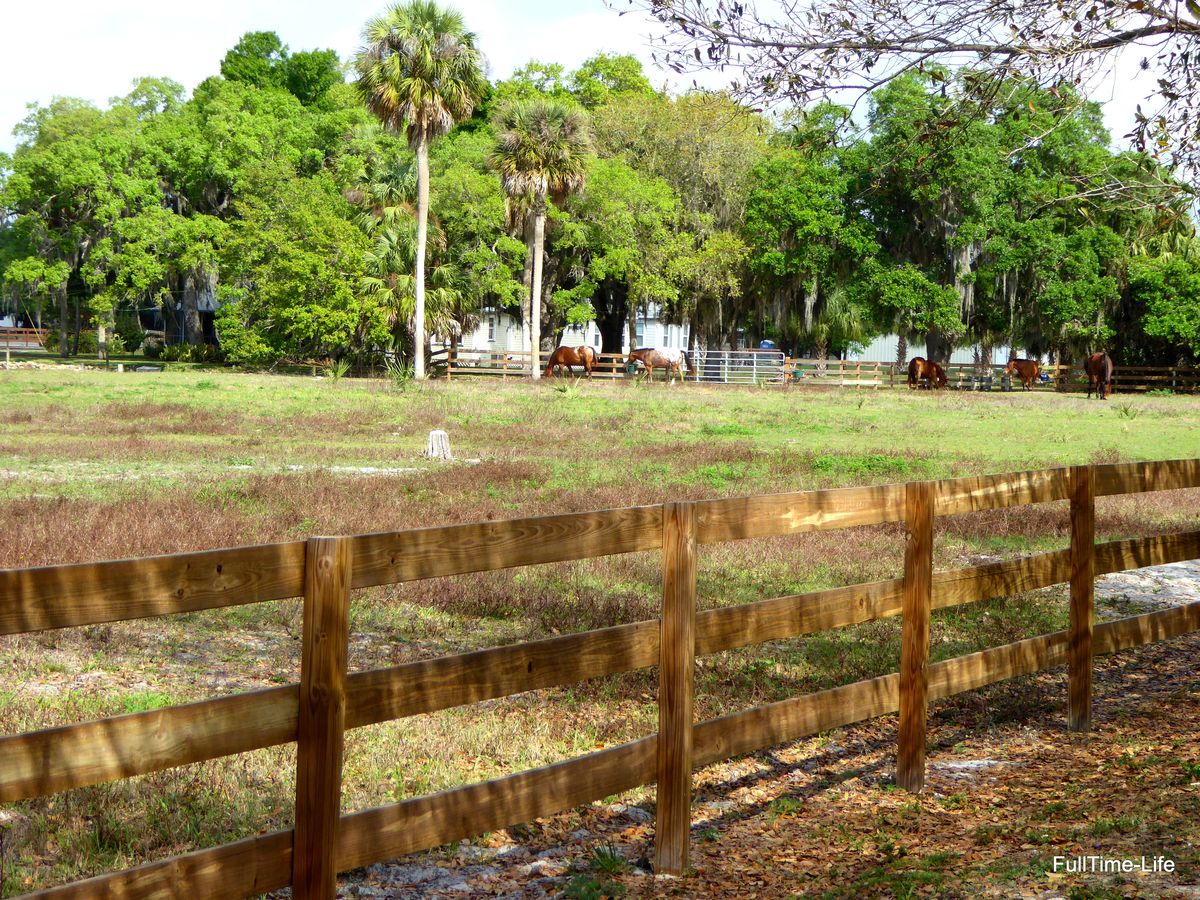
    Here are a couple of the other residents of the pasture where the local eagles live in their scrub pine.

    Sometimes there are as many as eight or ten horses.  

    P1000570


    They belong to the family who has installed the eagle cam.   I always park on the end of the church lot (on the other side of the pasture) and as far away from the nest as possible.  Both because I think it's better for the eagles and because its fun to watch the horses too. 

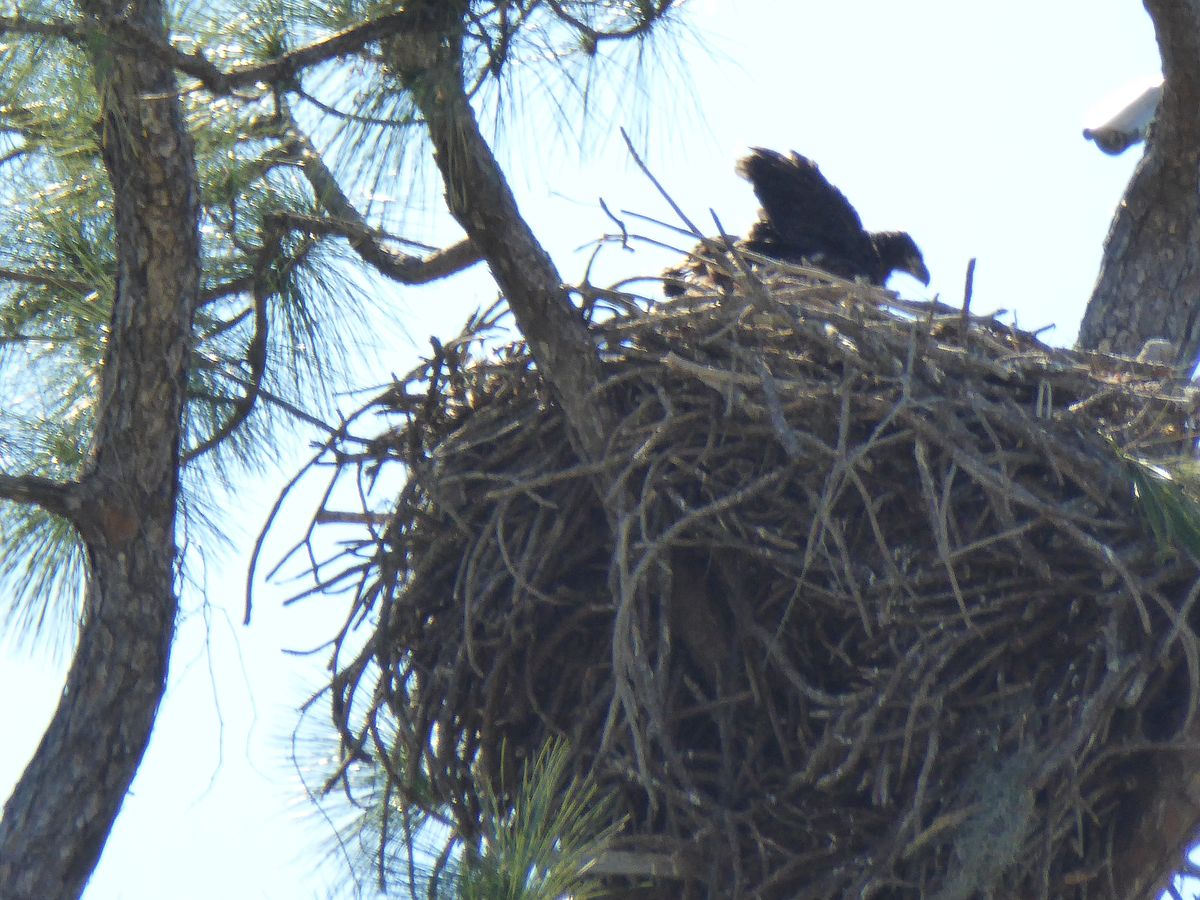
     Ozzie and Harriet weren't at home (really this time — they weren't anywhere in sight.)  E-6 was practicing his wing stretches and occasionally hopping up and down for fun and strength  building. 


    2015-03-15


     Branching should take place any day now (flying out of the nest to the nearest branch and back.)   On this day, he must have had a good meal recently because he wasn't making any noises at all.  And because probably he is getting more used to being on his own.   


    P1000565


    I was in the car getting ready to leave (and noticing the shadow patterns on the pasture fence) when a flock of cattle egrets flew down.


     2015-03-151


    Maybe they should be renamed — horse egrets?  In any case their mission was the same as it is when they land in cattle pastures.  


    Linking to WILD BIRD WEDNESDAY (thank you to Stewart) and to GOOD FENCES (with thanks to Theresa aka TexWis Girl).

  • BLUE HERONS — LITTLE and GREAT


    P1000407-001


    Little Blue posed  for us near Lake Okeechobee.

      P1000388-003


     Great Blue didn't even know he was getting his picture taken…


      P1000390


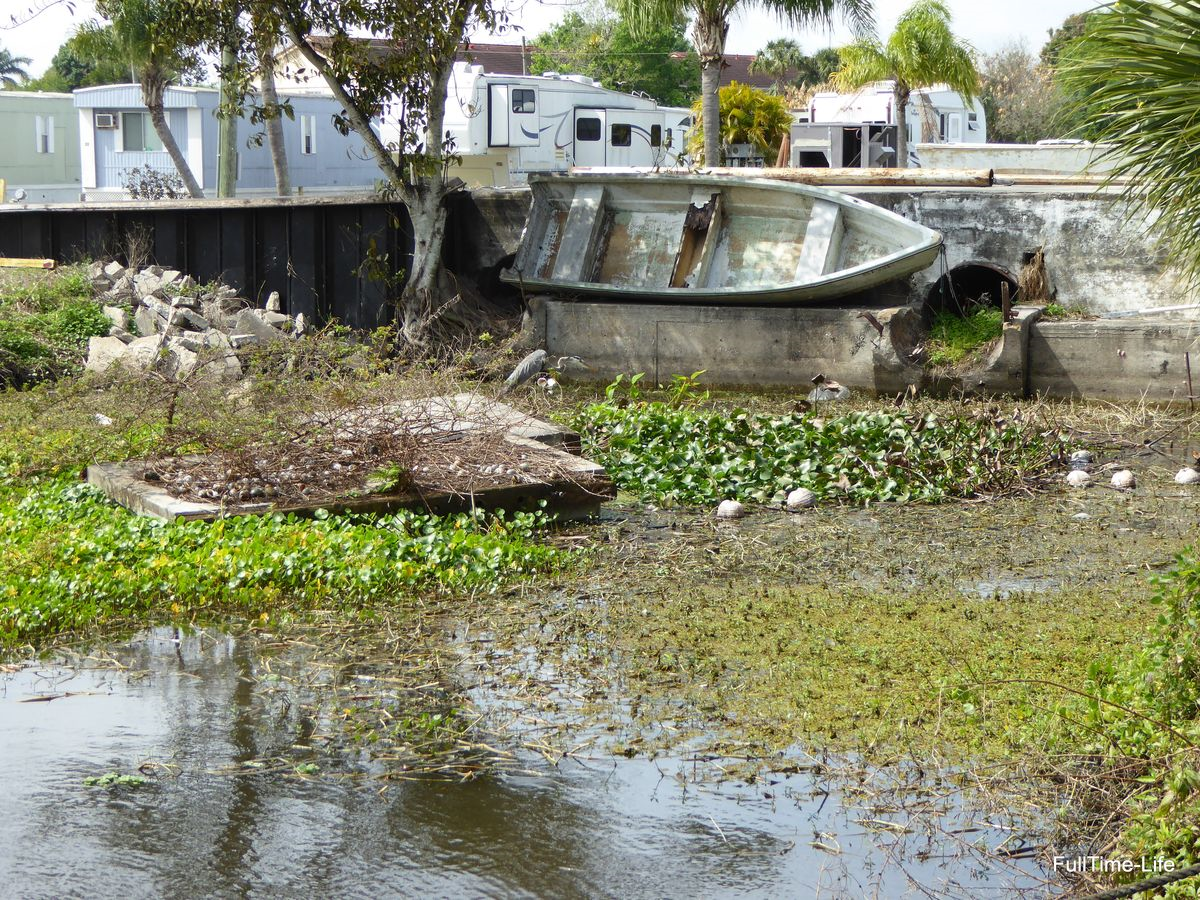
    …  because he was this far away.   He's a trailer park heron!  Of all the beautiful spots where a Great Blue could hang out, I wondered why he would pick this backwater.  There must be lots of fish in there as well as trash.

    Sometimes, slowing down with your camera means finding picture ops in the most unlikely places.


    P1000408-001


    One more shot of the Little Blue after he turned himself around.


    Linking to NATURE NOTES (thank you to Michelle); OUR WORLD on TUESDAY  (thank you to Sandy, Sylvia, Arija, Gattina, Jen, and Lady Fi);  and to  WILD BIRD WEDNESDAY (with thanks to Stewart).  

  • AT HOME IN THE PINE

    This is the third year that Ozzie and Harriet have starred on their own Eagle webcam.   Their tree home is a couple of miles from where we live here in Fort Myers, making it almost as easy for us to watch them either live as on camera.   I'm not quite as obsessed this year, since we saw so many bald eagles in Alaska last  summer, but I can't resist stopping by the nest once in a while. (And of course we were too early for eaglets in Alaska.)


    P1000292


    I stopped by to visit our neighbors last Saturday morning.    Here is Harriet enjoying the early afternoon sunshine.   


    P1000288


    Her little one woke up from a nap and soon started peeping plaintively.    It sounded like "Hey, I'm all alone here." 


    P1000291


     For all E-6 (the baby) knew, mom and dad could have been miles away, but the whole time I watched, Harriet was only this far from the nest, practicing a little healthy parental neglect.    Watching, waiting, starting to teach independence.  


    P1000307

    "Well, if there's not going to be anything new to eat, guess I might as well practice flapping my wings."


    P1000289


    I'd hoped to see Ozzie fly in with early dinner, but he didn't oblige.  Harriet and E-6 continued to wait (with differing degrees of patience), but I had errands to run.  Maybe next visit.


    (Harriet hatched two eggs again this season, but sadly last month E-5 died from unknown causes.     E-6 was about 50 days old in these pictures.)


     This post is linked to Eileen's SATURDAY CRITTERS  to Annie's RATHER B' BIRDING, and to Michelle's NATURE NOTES.  


    Thank you all  for hosting.


  • BIRDS IN BLACK and WHITE

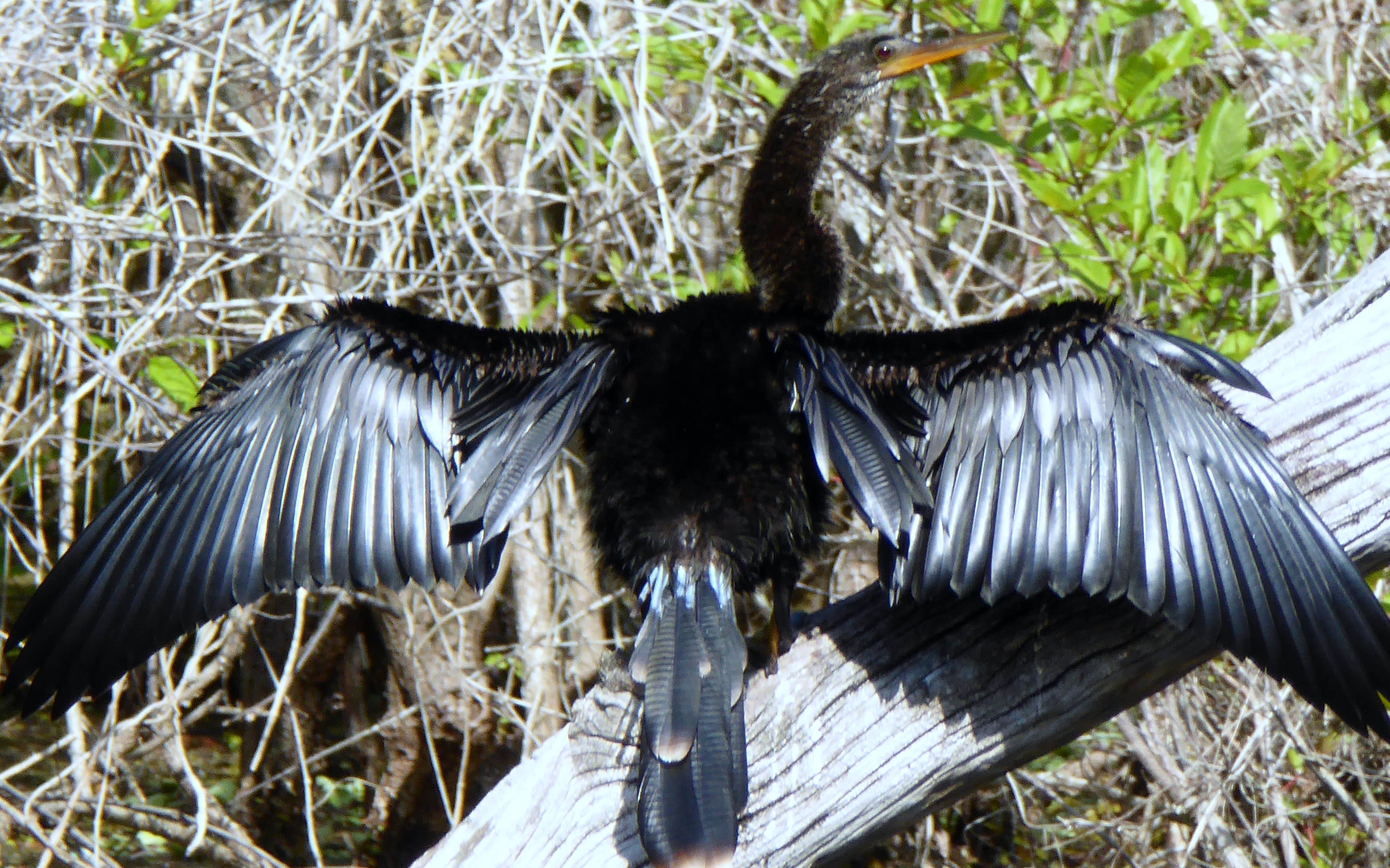
    Here's an Anhinga drying his wings.  These birds, like cormorants,  have no oil glands — so their feathers are not water repellent (the way ducks and duck-like birds are).  Both Anhingas and cormorants  move easily underwater, but they have to spread out their wings in the sunshine when they want to get dry.


     P1000252

    040Both birds also have long snakey-looking necks and both can move easily underwater.  The anhinga is a little bit bigger usually, but it can be hard to tell the difference between cormorants and anhingas.  

    The easiest  way to tell is that anhingas have straight beaks and cormorants have hooked ones.   

    I had to search through my archives to find this picture of a cormorant.  You can click to see it better.  

    For some reason, I really do like the Anhinga better and so I hardly ever take pictures of a cormorant. 

    (We  see the cormorant everywhere, but only see the Anhinga here in Florida.)


    P1000258


     I  took this picture of the Great Egret mostly because of the interesting  tree shadows in the swampy water.  We see lots of Egrets, pretty much everywhere we are (from Florida to Alaska and in-between).  So I don't always take pictures (even though I never tire of seeing them).


    P1000244


    It was a circular boardwalk (round-trip) and the Anhinga was still sitting on the same log on our return trip.  But this time, it looked like he was ready to get those wings wet again.   Just waiting for the perfect fish dinner to swim by.


    P1000255


     The Egret (or one very much like it) was still in the same spot as well.  But this time, he had been  joined by a whole flock of Ibis.   It looked sort of like it was babysitting the little ones (and letting them eat first apparently).


    LINKING to WILD BIRD WEDNESDAY (thank you Stewart);  to next week's SATURDAY CRITTERS (with thanks to Eileen); and to I'D RATHER B' BIRDING (thank you Annie).

  • CREATURES FROM THE SLOUGH


    We took a walk at Six Mile Cypress Slough last week.  This is a different nature preserve from the one I showed yesterday — we have to drive to it, but it's only a few miles away.     We usually see more birds and animals at Six-Mile than we do at the preserve next door.   


    P1000190


    The little blue heron seemed to be lecturing the anhinga — maybe he wanted that old raft all to himself.


    P1000186

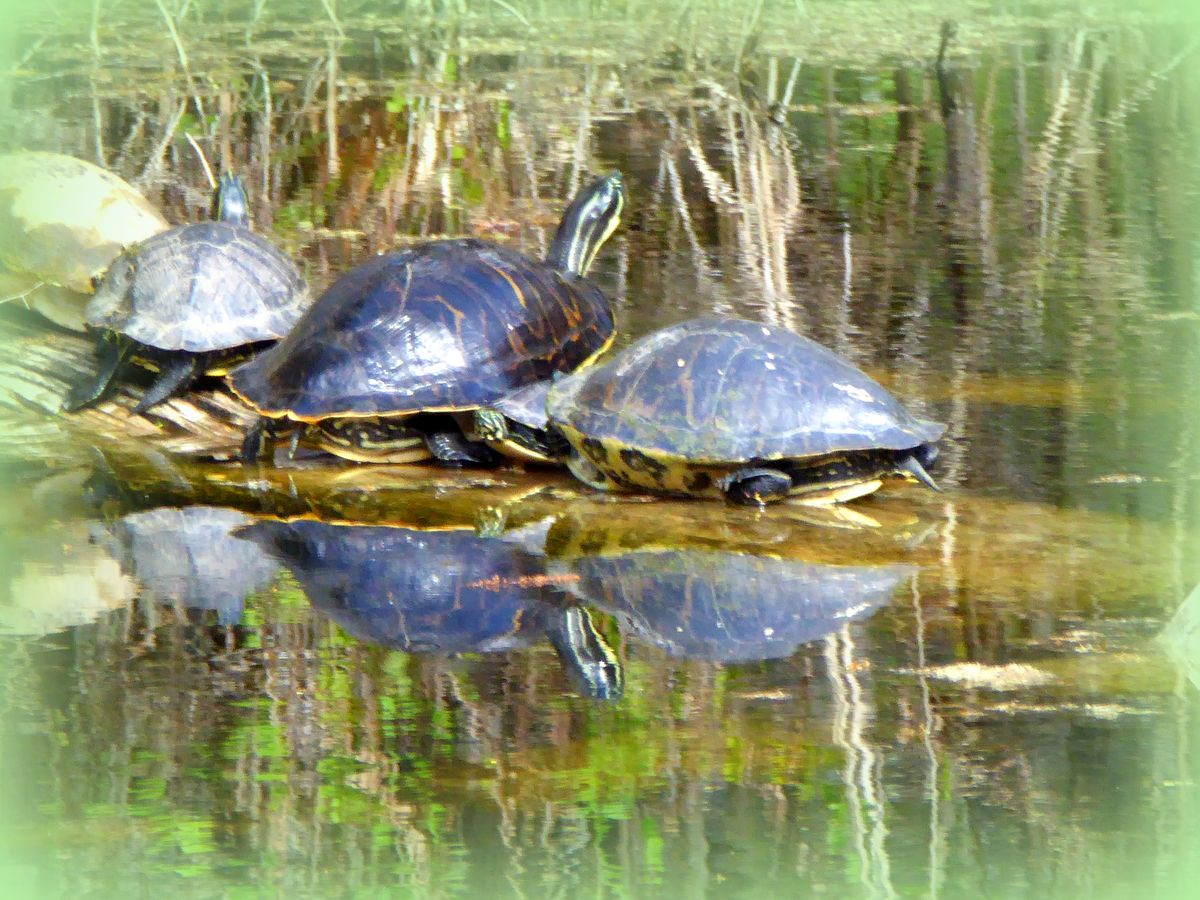
    Turtles enjoying the winter sunshine.


    P1000189


    Nap time for this guy!


    P1000198


    Three little turtles sitting on a log …. and three reflections in the reeds.


    P1000219-002


       The patient fisher-bird.  Those are feathers scattered in the duckweed.  


    Linking to WILD BIRD WEDNESDAY (thank you Stewart) and to next weekend's SATURDAY CRITTERS, with thanks to Eileen.


  • FRUSTRATIONS OF AN AMATEUR BIRDER


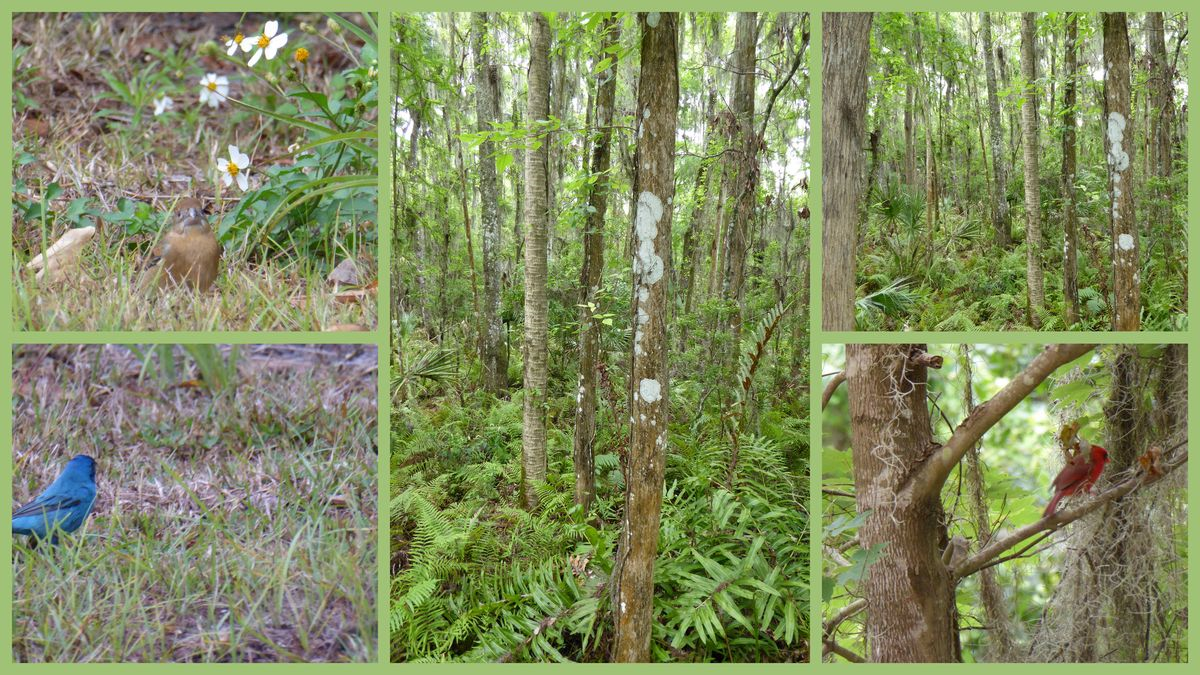
     Birds.  What great lengths they will go to to keep me from taking their picture.


    misc birds Chesnut Park

    Chesnut Park, Pinellas County


    They camouflage themselves (on purpose, I'm sure) by insisting on blending into their surroundings.

    A whole flock of them settle to the ground right in front of my eyes, but fly as soon as  I touch the camera (all but one indigo bunting, who was obviously a little slow).

    They drum on the trees and sing in the forest, but never ever show their faces.

    They hide in mossy trees (but this time, Mr Cardinal,  I caught a glimpse of you anyway).   


    Misc shorebirds, Honeymoon Beach

    Honeymoon Beach State Park


    Birds.  They hide their eyes.  They turn their backs on me.

    They stay just out of camera range.

    They blend into the  water where they're feeding   (did I say something like that already?).


      Marbled Godwit

    But it is all worth it.  Because we are outdoors.  Birding.  Exploring.   Enjoying the wonderful weather.   And sometimes a professional birder (real or virtual) helps this amateur identify a bird that is new to me.    Life is good!


    ( A birder at Honeymoon Beach told me that this bird is a Marbled Godwit.  He was way more excited about this guy than he was the skimmers that I took a million pictures of (here).     Thanks also to all of you — my virtual birding experts — who told me the bird in the background of my skimmer picture was a ruddy turnstone!  

    Birders, whether virtual or standing right beside me in real life, are the most helpful sharing people in the world!


    FOR:   OUR WORD TUESDAY (very late … we were away yesterday) and WILD BIRD WEDNESDAY.


    Thank you to the whole great host team at OW and to Stuart at WBW.

  • BLACK and WHITE


    The uniform of the day in the shallows at Honeymoon Beach State Park was black and white, although a touch of red or orange was acceptable. … welcomed, even.   


       P1000019


    We saw a few terns, some gulls, and so many black skimmers we couldn't  count them.

    The little brown job in the background (a ruddy turnstone*) is obviously leaving because he isn't wearing the correct colors. 


     *Thanks to all who identified that bird for me!  Your help is appreciated!!

      P1000018


    This is only the third time we've seen skimmers.  I love the colors — but still think it's weird that they don't seem to have eyes.


    P1000027-001


    A few cormorants even joined the party for a while.


      P1000028


     SHARED WITH WILD BIRD WEDNESDAY.  Thanks to Stewart.


  • PEACOCK


    We've seen quite a few peacocks in zoos and nature parks over the years —  but never looked as closely  as we did at the one we saw last month.    For the first time, I realized that his tail feathers look more like an exotic plant than part of a bird!  Mysterious nature.


      P1040131-001


    There were no  hens in sight, so this peacock felt no need to display his magnificant tail.  He  just dragged it behind him everywhere he went.   Not that he had much choice.   


    P1040126


    And we didn't have much choice but to look at this guy because everywhere we went at Gatorama,  he was right there beside us. 


    P1040129


     So when we downloaded our pictures, there was this proud peacock  in between every set of alligator photos.    (Click here to link to the Gatorama post with all those not-so-pretty critters.)


    P1040128


     That tail looked heavy and uncomfortable in the Florida heat.

        But it didn't seem to bother him at all.   


    P1040133


    Of course he doesn't know any different.  And he has such a tiny head for such a big bird — I don't think there's room in it for many thoughts about anything. 


    SHARING with:  SATURDAY CRITTERS and  I HEART MACRO .  Thank you to Eileen for Saturday Critters and to Laura for I Heart Macro.  


  • KENTUCKY CARDINAL in FLORIDA


    When I was growing up in Eastern Washington State, the only Cardinals we ever saw were those on Christmas cards.  But whenever we opened one of those cards, my mother (who was born and raised in Kentucky)  would always mention that it was her favorite bird when she was a child.


    P1040125


    That made quite an impression on me because really my parents weren't what you would call nature lovers.   In fact, our family  didn't do much outside at all, but my mother had grown up in the country and ridden horses and (apparently) enjoyed nature before she migrated out west.   I liked hearing about what seemed to me her different and exotic past life.  


    2014-03-312


    So I didn't see a real cardinal until years and years later when Bill and I traveled South for the first time.   And when we saw our first one as we were driving, I yelled for him to stop the truck … I was so excited.     I did soon realize that these were fairly common birds in other parts of the country … they just don't hang out in the Pacific Northwest.    Although we see them more often nowadays, I still get excited… they'll never be a commonplace bird to me.

    This cardinal is  one we  spotted  on a day trip here in Florida just last month.  He kept posing so beautifully that I thought the least I could do was to post him to   WILD BIRD WEDNESDAY.  Thank you Stewart.

  • GATORAMA

     Sharing another only-in-Florida adventure with OUR WORLD TUESDAY.  Thank you to the host team.


      P1040096


     When DisneyWorld opened in 1971, it changed the scene for Florida tourist attractions.  Before Mickey Mouse,  there were  many mom-and-pop roadside attractions, all trying to capitalize on exotic Florida nature.   After Mickey and all that came along with him, most of these attractions fell into disrepair.  Some of them, like the mermaids at Weeki Watchee Springs,  which we visited last year, have been bought and restored by the State and are now operated as State Parks.    

    P1040177


    Last week we visited an original Southwest Florida roadside attraction that has survived pretty much as it was when it opened in 1957.  This is GATORAMA in Palmdale.    It is still owned and operated by the same family that started it back then.


      P1040092

    There's nothing fancy about Gatorama; it did feel as if we were back in another era.   You walk down a long elevated walkway with a tin roof overhead and on either side are alligators and crocodiles swimming free,  tortoises and turtles (apparently unafraid of their neighbors), a few exotic birds in cages, and quite a few wild birds dropping by here and there.  

    There were also many juvenile alligators in pens.

      P1040153

     (The pens were spacious — we were told that this behavior — called podding — is normal for juvenile alligators).


    Gatorama  advertises itself as an Alligator and Crocodile adventure, but it is also an alligator farm.  Alligators are raised for meat and leather.    And that of course  is one reason why the attraction has survived.    Diversification is the name of the game!

    P1040161

    This young woman was cleaning one of the alligator pens.  First she had to herd the gators into another pen.  Take a closer look at her feet. 

    We didn't stay for the show — which included alligator wrestling and a chance for kids to touch an alligator (with its snout taped).  It was enough for us to see the animals — and an almost barefoot alligator herder (ironically, she was actually wearing Crocs).