Category: Six Mile Cypress Slough

  • AFTER THE RAIN

    We had a huge rainstorm last Monday afternoon —  walls of water for three hours straight.  Since we're from western Oregon originally, we're used to rain — or should be.  But there, the winter rain usually just kind of drips softly and steadily for all day (and all the next day and the next ….).     Here in Florida, it gushes and then when the storm is over, it's over.  


    P1000551

    Fungi "blossoming" after the rain


    (We need more adjectives for rain … the way there is supposed to be a hundred or so words to describe snow in the Native Alaskan's vocabulary.)


    P1000670-001

    It wasn't raining at all on Tuesday morning but at the Slough there was water where it was dry the week before.    The reflections sparkled and the clean 'after-the-rain' scent was delicious.  

    (And surprisingly and happily there were no mosquitoes.) 


    2015-03-26


    The epiphytes were blooming and I spotted my first pink lichen on a couple of trees.


    2015-03-261


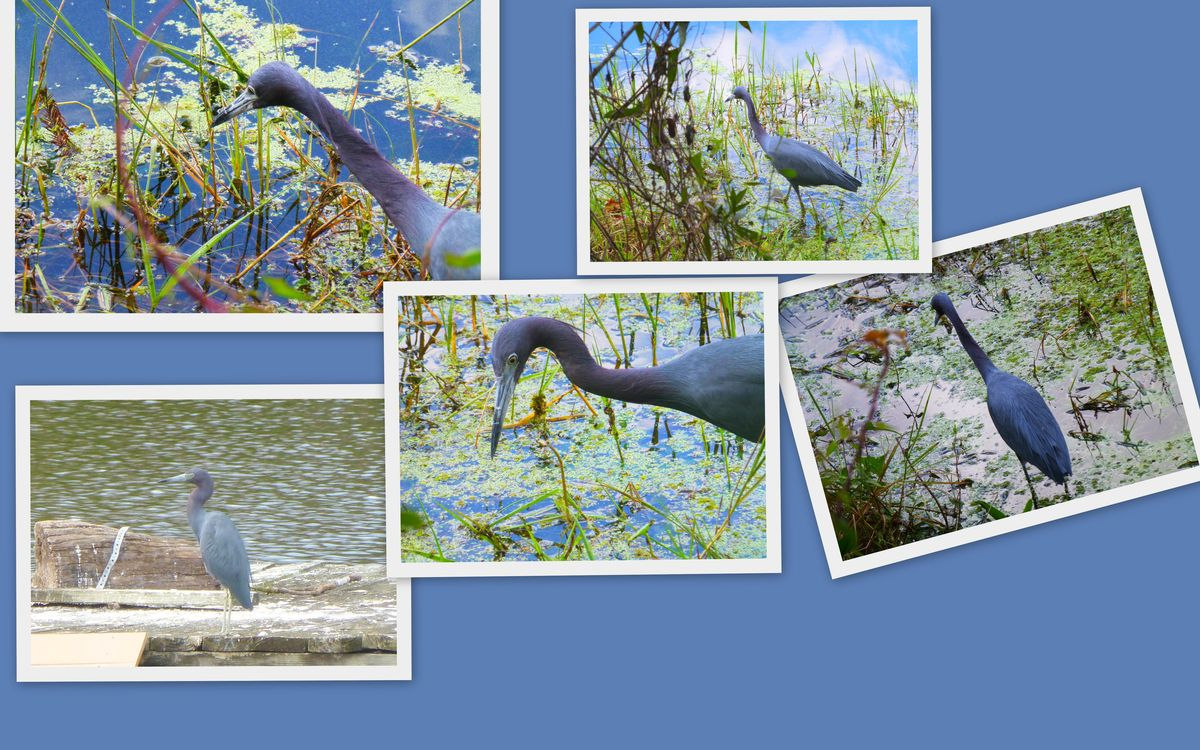
    I thought I was taking pictures of a black-crowned night heron, but it sure looks bluer than usual if it is.  Didn't do anything to change the color of the photos, so maybe it's a trick of the light.  Or maybe it's another bird.  (Help always welcome.)


    P1000669


    Another beautiful day at the swamp.   There's nothing better than taking advantage of the wonders of the rain storm without actually having to get wet! 


    LINKING to SCENIC WEEKENDS (thank you Gemma); to I HEART MACRO (thank you Laura); to MONDAY MACRO (again thank you Gemma); to MOSAIC MONDAY (thanks to Judith); NATURE NOTES (thank you Michelle)  and to WILD BIRD WEDNESDAY (thank you to Stewart).

  • SLOW-WALKING


     Small treasures from slow walks.


    2015-03-153


    Blue meditation (walking after Yoga class) at Six Mile Cypress Slough last week.


    2015-03-221


    Sunday stroll at Caloosahatchie Nature Preserve.    The mushroom kind of looks like a butterfly left a self-portrait  on it.


      2015-03-222

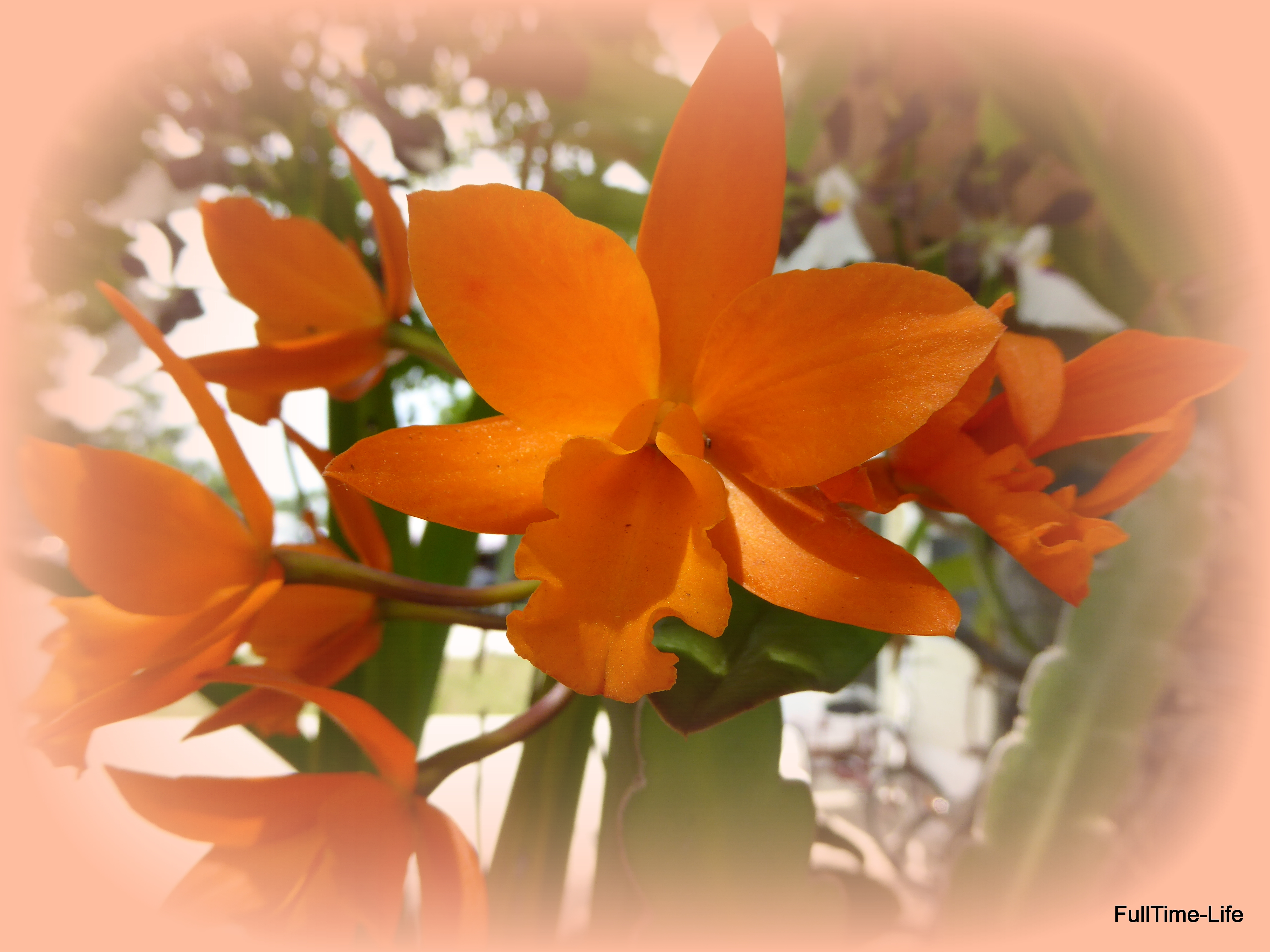
     More beauty from our orchid-growing  neighbor here at Upriver Resort.


    P1000661


     And finally, left over from whenever the last full moon was:

    2015-03-081


     (No walk at all  – taken about 10 steps from the back door.)


    Thank you to Laura for I HEART MACRO; to Gemma for MONDAY MACRO; to Judith for MOSAIC MONDAY; and to Lady Fi, Sylvia, Sandy, Gattina, Arija, and Jenn for OUR WORLD TUESDAY.   

  • BIRDS IN BLACK and WHITE

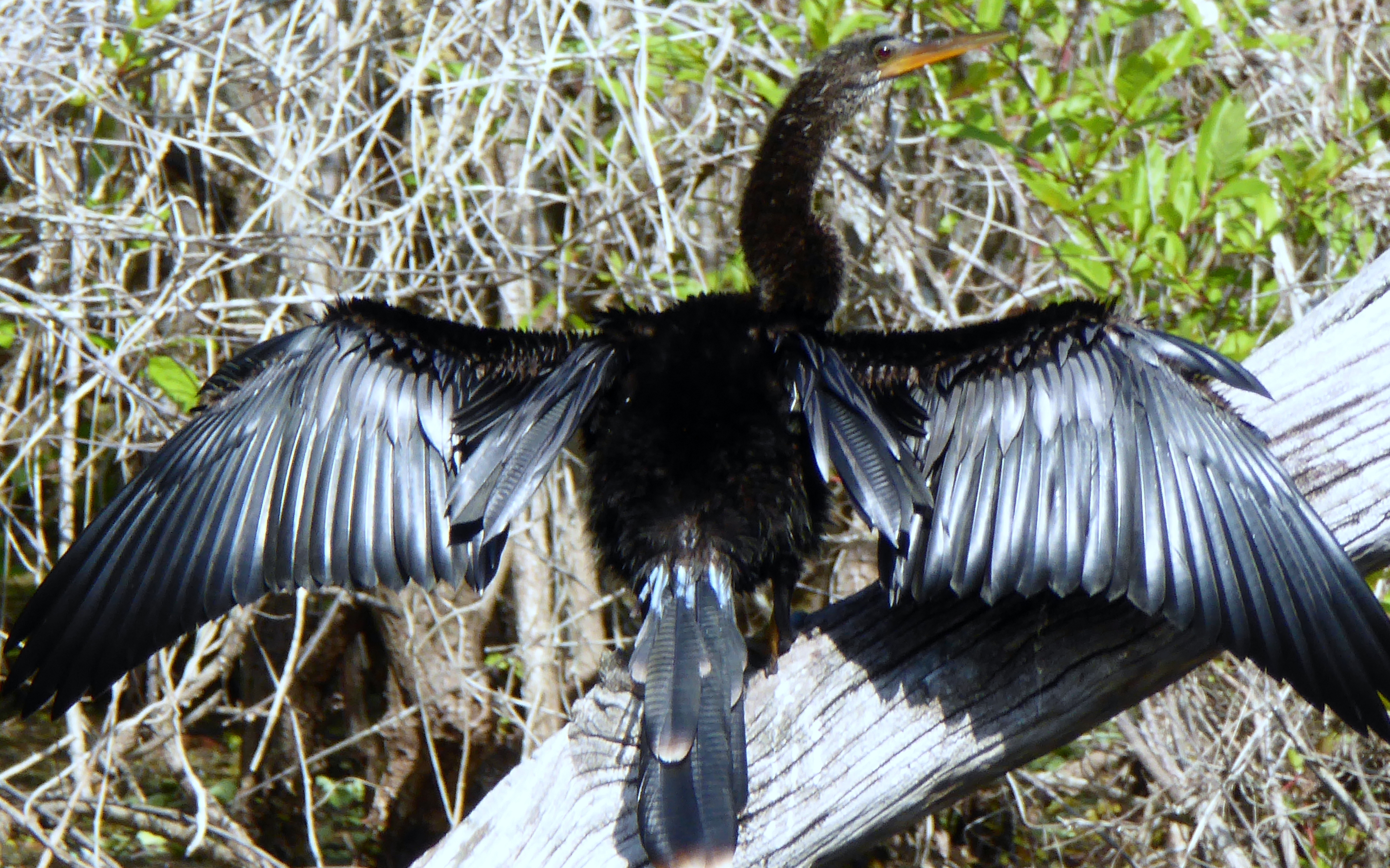
    Here's an Anhinga drying his wings.  These birds, like cormorants,  have no oil glands — so their feathers are not water repellent (the way ducks and duck-like birds are).  Both Anhingas and cormorants  move easily underwater, but they have to spread out their wings in the sunshine when they want to get dry.
     

     P1000252

    040Both birds also have long snakey-looking necks and both can move easily underwater.  The anhinga is a little bit bigger usually, but it can be hard to tell the difference between cormorants and anhingas.  

    The easiest  way to tell is that anhingas have straight beaks and cormorants have hooked ones.   

    I had to search through my archives to find this picture of a cormorant.  You can click to see it better.  

    For some reason, I really do like the Anhinga better and so I hardly ever take pictures of a cormorant. 

    (We  see the cormorant everywhere, but only see the Anhinga here in Florida.)


    P1000258


     I  took this picture of the Great Egret mostly because of the interesting  tree shadows in the swampy water.  We see lots of Egrets, pretty much everywhere we are (from Florida to Alaska and in-between).  So I don't always take pictures (even though I never tire of seeing them).


    P1000244


    It was a circular boardwalk (round-trip) and the Anhinga was still sitting on the same log on our return trip.  But this time, it looked like he was ready to get those wings wet again.   Just waiting for the perfect fish dinner to swim by.


    P1000255


     The Egret (or one very much like it) was still in the same spot as well.  But this time, he had been  joined by a whole flock of Ibis.   It looked sort of like it was babysitting the little ones (and letting them eat first apparently).


    LINKING to WILD BIRD WEDNESDAY (thank you Stewart);  to next week's SATURDAY CRITTERS (with thanks to Eileen); and to I'D RATHER B' BIRDING (thank you Annie).

  • LEARNING — NATURALLY


    Things are different here!  

    It has taken years as a winter resident just to get over just marveling at the beauty (and sometimes eeriness) of the natural world here in Southwest Florida.   By now though, we have walked enough trails and explored enough  that it is  time to learn a little bit more about what we're seeing.   Maybe by sharing some of what I've learned I will actually remember it.  


      2015-02-033

    Epiphytes

    Epiphytes are plants that grow on  other plants.  They are not parasites as they draw food and energy from other sources.  The host tree is simply used as support, and to take advantage of the additional sunlight found in the upper part of the forest.


    P1000195


    Cypress Knees 

    These little cone-shaped stumps are called cypress knees.  They grow upward from the horizontal root system of the cypress trees.  They help to stabilize the tree in the mucky soil and may also help the tree to breathe when the water is deep.    New trees will not grow from the knees.


    P1000205


     Lichens

    These are not patches of paint on the trunks.  They are lichens — a combination of an algae which produces food and a fungus which provides physical support.   Mostly we see white, but they can also be green, gray or pink.    They do not harm their tree and are actually an indication of a healthy forest.


    Linking to MOSAIC MONDAY, to  OUR WORLD Tuesday and to NATURE NOTES.

    Thank you to the hosts:

     Lady Fi, Arija, Sylvia, Sandy, Gattina, and Jenn are the Our World team.

    Nature Notes is hosted by Michelle at her blog Rambling Woods.

    and Mosaic Monday is brought to us by Judith who blogs at Lavender Cottage. 

  • SCENIC BOARD WALK


    P1000254


    The Boardwalk at the Slough, early February 2015


    2015-02-03


    I know that walking at Six Mile Cypress Slough makes me feel happy —

    — and so does linking to Theresa's GOOD FENCES  and to Gemma's SCENIC WEEKENDS.    Thank you to both of these great hosts (and amazing bloggers).


  • SKIES OF THE SLOUGH


    In the strange and wonderful world that is  Six Mile Cypress Slough it is easy to become a little bit disoriented.    

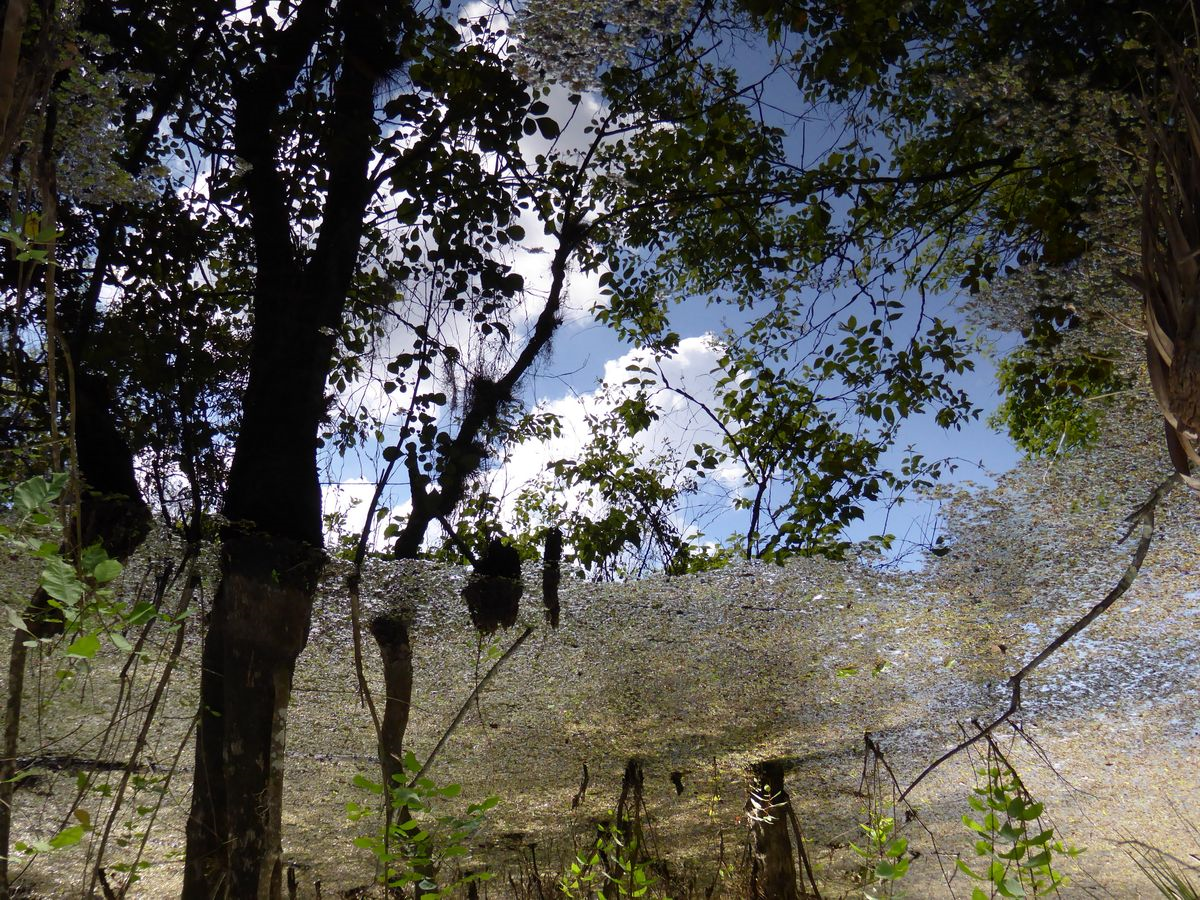
    P1000211


    Sometimes you can't be sure if you're looking up or down.  The picture above is straight-out-of-the camera, but if I rotated it, I think it would look more natural than it does this way.

    Let's find out:

    P1000211-001

     Now I'm even more confused than usual.


    2015-01-25


    Looking out at the beautiful blue skies (top row) and getting a kaleidoscopic, slightly distorted view of the same ones by looking down at the reflections through the duckweed and ripply slough water. 


    P1000193

     Just an ordinary peaceful blue January winter sky here in this corner of the world…

     … where life is good, even  if  sometimes a little bit off-kilter.


    Sharing with everyone who enjoys gazing at the sky — whether up or down — by linking this post to  SKYWATCH FRIDAY and with my fellow scenery junkies at SCENIC WEEKENDS.


    Thank you to Yogi, Sylvia, and Sandy for SWF and to Gemma for SW.


  • CREATURES FROM THE SLOUGH


    We took a walk at Six Mile Cypress Slough last week.  This is a different nature preserve from the one I showed yesterday — we have to drive to it, but it's only a few miles away.     We usually see more birds and animals at Six-Mile than we do at the preserve next door.   


    P1000190


    The little blue heron seemed to be lecturing the anhinga — maybe he wanted that old raft all to himself.


    P1000186

    Turtles enjoying the winter sunshine.


    P1000189


    Nap time for this guy!


    P1000198


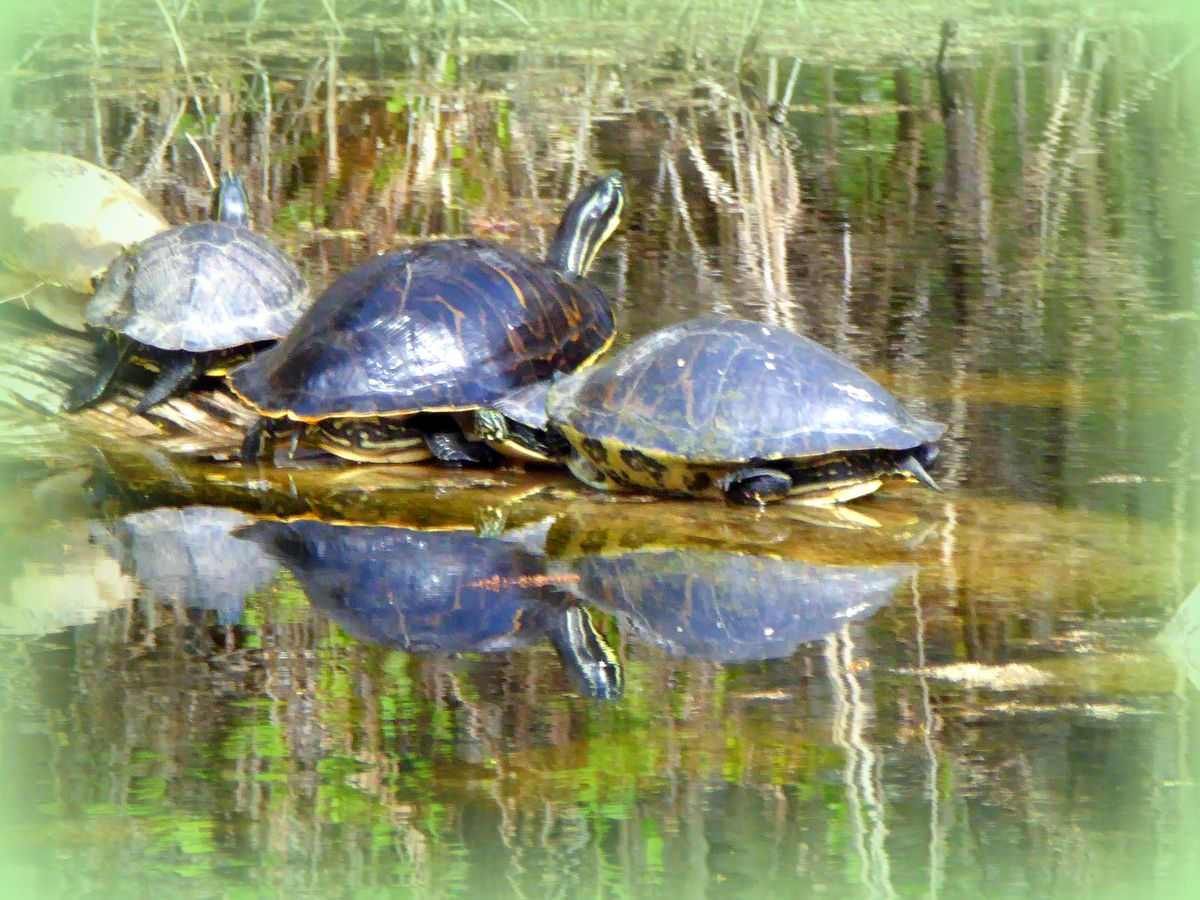
    Three little turtles sitting on a log …. and three reflections in the reeds.


    P1000219-002


       The patient fisher-bird.  Those are feathers scattered in the duckweed.  


    Linking to WILD BIRD WEDNESDAY (thank you Stewart) and to next weekend's SATURDAY CRITTERS, with thanks to Eileen.


  • BIRDS OF THE SLOUGH


    From a walk at Six Mile Cypress Slough.    

     Note:  Thank you to Gordon and Gail who corrected my ID in the top picture … that beautiful fellow is a green heron not a tri-colored.  I should have checked my book first!   I've fixed the caption.


    P1030824-001

    Green heron


    These birds were kind enough to pose for the camera during our walk.


    Anhinga

    Anhinga drying its wings

    We're having slow computer issues, so I'm not even trying to say much about these birds.   


    BIRDS OF THE SLOUGH

    Little blue heron

    But who needs words?


    Ibis and immat ibis

    White ibis — mature and immature


    They are all the usual suspects.  But I never tire of seeing them.  

    P1030806-001

    Great Egret


    Linking to WILD BIRD WEDNESDAY.   Go birding!  Thank you Stewart.

  • SCENIC SLOUGH


    Last Monday, we walked at Six-Mile Cypress Slough — one of our favorite places  here in Fort Myers.  This urban getaway is right in the middle of the City — only about 20 minutes from where we live.    


          P1030820-003


     There is  more water in the slough this year.  That's a good thing.  It rained a lot here last summer — as it is supposed to during the summer rainy season.  


    P1030795-002


    A mixed bag of critters enjoy a  floating raft in the pond.  Here we have a cormorant, a handful of turtles, and a little blue heron sunning themselves.


      P1030818


    Cypress knees  seem like they belong in a fantasy story.


    P1030805-001


    This great egret posed  beautifully at the end of  a walkway.

    P1030812-002
    P1030814-001


        Airplants were growing all over  the swamp.    They also seem unworldly.


    THIS post is linked to SCENIC WEEKENDS (thank you Gemma) and SATURDAY CRITTERS (thank you Eileen).    

  • WATER COLORS FROM THE SWAMP


    Looking back .  It's a good reminder that we need the summer rainy season here in Southwest Florida, so that our swamps and sloughs will still be wet and wild during the winter dry season!


    Swamp refl016SC


    Swamp038


    Swamp cypress knees046


    For Gemma's SCENIC WEEKENDS and STRAIGHT OUT OF THE CAMERA also hosted by Gemma, along with Magical Mystery Teacher.     Thank you!